Wishing for that First Fall Frost

I can't help but look forward to that 1st frost of Fall. I'm embarrassed to admit that the weeds have truly overtaken my garden. What I intended to be a paradise of fragrant and colorful flowers has turned out to be a tangled mess of ugly vines and weedy plants with a few colorful beauties mixed in. The first frost will kill all the ugly things, for which I will be very grateful.


But also, that frost will make some plants better. Turnip and mustard greens are not really tasty until touched by that crisp first frost. Many of our shrubs and trees known for their vivid Fall colors will not color up until nights turn cold.
Itea Merlot in Fall


One of my favorite fall chores is riding the lawnmower around chopping up all the leaves before they are sucked up into the bagger. I then spread them out all over my planting beds. Winter rains (I'm keeping my fingers crossed that they come!) will help the leaves to rot and break down, enriching the garden soil.

Cooler temperatures in the Fall are absolutely perfect for planting and transplanting. Perennials, trees, and shrubs establish much better when put in the ground right before winter. Down South where we are, the ground doesn't freeze, so plant roots continue to grow all winter while topgrowth takes a rest. During the winter, plants can get their roots down deep into the ground to reach water and nutrients before having to expend any energy growing new leaves, stems, and flowers.

But also, that frost will make some plants better. Turnip and mustard greens are not really tasty until touched by that crisp first frost. Many of our shrubs and trees known for their vivid Fall colors will not color up until nights turn cold.

Cooler temperatures make gardening more enjoyable. Last week, the outdoor temperature was 96 and the humidity was so high that our heat index was over 100 degrees, so everything I had to do out there was a real chore. This morning, the cool breeze reminds me of my favorite gardening weather. When temperatures are cool enough to wear long sleeves in the garden, I will think I'm in Heaven. There's just something about working in the garden when it's too cool to sweat that I just love.

While others might dread the cold weather, not me. Is it wrong for me to wish for that first frost of Fall? I don't think so.

Hydrangea arborescens: Wildlife Value of the Smooth Hydrangea

If you have seen the lovely Annabelle Hydrangea, you love her. Hardy, easy to grow, and beautiful in summer, Hydrangea arborescens 'Annabelle' is probably the most versatile hydrangea you can grow in the garden.

Large voluptuous white blooms appear in early summer, despite the severity of your winter or any pruning that might have been done too late, because this hydrangea blooms on new growth. Additionally, Our native hydrangea arborescens, will bloom again in late summer if spent blooms are removed.

Hydrangea arborescens, also known as smooth hydrangea, is native to the Eastern United States. Annabelle is a selection known for its particularly large white blooms that can be up to 10 inches across.

Hydrangea Sphinx Moth
 photo from www.bugguide.net


You might already know the beautiful attributes of Hydrangea arborescens, but did you know Annabelle Hydrangea also has wildlife value? Here at Shady Gardens, we try to do all we can to encourage a diverse population of wildlife. Our garden is a sanctuary for birds, butterflies, insects, and mammals of all kinds. Hydrangea arborescens is a favorite host plant for Darapsa versicolor, which is also known as the Hydrangea Sphinx Moth. This Sphinx Moth pollinates the flowers on Hydrangea arborescens, then lays eggs on the leaves. 


Darapsa versicolor larva photo from www.bugguide.net


The Eggs develop into larvae which then feed on the leaves of the shrub. If you find a green caterpillar like the one shown here on the leaves of your Annabelle Hydrangea, you can count yourself blessed, because Darapsa versicolor is rarely seen.

Pink Annabelle Hydrangea at Shady Gardens Nursery


A pink-blooming form of Annabelle has been developed, so look for it at your local garden center or online.


(Hydrangea Sphinx Moth Photo credits: http://bugguide.net/node/view/411927, Nolie Schneider 2010 and Floyd Williams 2005.).


Groundcovers: An Important Part of a Southern Garden

I love groundcovers. There’s just something about them that makes me want to have every one I see. 

Groundcovers can be an important addition to our Southern gardens. They act as a living mulch, helping to conserve moisture around trees and shrubs.  

Many groundcovers are evergreen, so they add beauty to the garden in every season. There are groundcovers that bloom, and even groundcovers that make berries! 

Groundcovers can be found that thrive in sun, shade, and even the most difficult dry shade. 

Whether your taste for plants leans toward the exotic, like Hellebores and Rohdea, or if you prefer native plants, such as native ferns, consider adding them beneath the shrubs in your garden. 

There are many native groundcovers that are evergreen, and some even produce berries, like Mitchella (Partridgeberry). Groundcovers like creeping phlox can help control erosion. 

Ajuga Bronze Beauty
Good groundcovers for sun include the sedums, ice plant, and rudbeckia (Black eyed Susan.)  Certain rose varieties also make excellent groundcovers. 

Ajuga is a great groundcover for crowding out weeds in shade or partial shade. It is not invasive.

English Ivy Overtakes the Garden
Beware of groundcovers that can take over the garden, seeming to eat other plants alive, crowding out everything else. Instead of invasive English Ivy or the popular Japanese pachysandra, try our native pachysandra, Allegheny Spurge. Or if it’s a vine you’re after, plant Crossvine, Carolina Jasmine, or Red Trumpet Honeysuckle—all native vines that will not overtake your garden.  

Butterflies and Tips for a Butterfly Garden

Butterflies are probably everyone’s favorite garden creature. They are beautiful, mysterious, and romantic. It’s a goal of many gardeners to attract these lovely butterflies into the garden.

Butterflies need just 3 things: Water, a nectar source, and host plants on which to lay their eggs.

Water
All living creatures need water. The preferred source of water for butterflies is a mud puddle. This can be easily created by filling a large clay saucer with clean sand. Place this in a sunny spot in your butterfly garden and keep it moist at all times.

Butterfly on Buttonbush

Food Source - Nectar for Adult Butterflies
Nectar plants are the food source for adult butterflies. You’ll need Butterfly Bush of course, which is now available in many colors. Lantana can’t be beat for attracting butterflies. Clethra is a large-growing shrub that produces sweetly scented flower spikes up to 6 inches long in either pink or white and attracts butterflies by the hundreds. You'll enjoy the fragrance as well, which reminds me of fresh honey. Clethra, also known as Summersweet and Sweet Pepper Bush requires moist soil and full to partial sun. Joe Pye Weed comes in many forms. Helianthus is another late-blooming flower that butterflies love—it has large yellow sunflower-type blooms on tall stems. Of course all the beneficial insects, including butterflies, love Blackeyed Susan, Gaillardia (Blanketflower). In September, butterflies are attracted to Stonecrop (Sedums like Autumn Joy, Matrona, and Vera Jamison.) Dianthus flowers just about all summer, and butterflies are particularly attracted to this plant. You can fill in between bloom times of the perennials with annuals like cosmos, marigolds, and zinnias. 

Fennel is a Host Plant for Butterflies
Food Source for offspring (a place to lay eggs) - Host Plants 
Host plants are those on which butterflies lay their eggs. Yes, the larva will eat the plants, but without a place for the babies to grow into the beautiful adult butterfly, you can’t have the butterflies! So plant extra parsley, dill, fennel, and milkweed, so you can have plenty to share with the butterflies. An added bonus is that these plants also attract many other beneficial insects!
 
I did say that butterflies need just 3 things, however there is a 4th thing that is the most important of all: Never use pesticides in your garden. Using pesticides would kill the butterflies you are trying to attract. Use insecticidal soap instead.

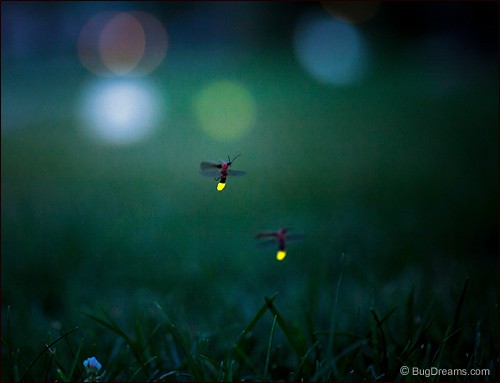
Lightning Bugs, Fireflies: Beneficial Insects for the Garden

We call them lightning bugs, but in some parts of the country they’re known as fireflies. Whatever you call them, we all enjoy seeing them flitting around and lighting up on summer nights. 

Photinus pyralis image from focusingonwildlife.com
Many of us enjoyed catching them and placing them in a lidded jar on our nightstand when we went to bed at night, but did you know that lightning bugs are beneficial insects? 

Lightning bugs are actually beetles that have a soft outer shell instead of a hard one. Lightning bugs lay their eggs in soft mud. Maybe that’s why we have so many this year—if you’ve been out to our place, you’ve seen our mud! 

It’s the larvae that are so helpful to gardeners—eating pests like snails, slugs, cutworms, and other larval pests. The larvae are luminous as well, lighting up all the time, but turning off their light when disturbed. For this reason they’re called Glow-worms. 

Researchers are also studying lightning bugs because they contain two rare chemicals that are used to fight cancer, multiple sclerosis, cystic fibrosis, and heart disease. So next time you’re sitting outside enjoying a warm summer evening, think about the wonderful little lightning bugs and all the other benefits God is providing for us in nature!

Fragrant Swamp Azalea: Rhododendron viscosum


If you like fragrant plants, you'll want Rhododendron Viscosum in your garden! Most often referred to as Swamp Azalea, Rhododendron Viscosum is a native azalea found in the Eastern United States. Pure white blooms in early summer have a pleasing spicy scent reminiscent of cloves. 
Rhododendron viscosum in June

Swamp Azalea, as the name implies, is one of the few azaleas that can tolerate periodically wet soil. This plant can grow in regular garden soil, but it does not want to miss out on water. If you can water regularly when rainfall is absent, Swamp Azalea will be easy for you to grow in your garden. Grows into a very tall shrub when planted near a pond or stream. Swamp Azalea is the perfect native rhododendron for a rain garden.

Rhododendron Viscosum can be grown almost anywhere in the United States since it grows well in USDA Hardiness Zones 4-9. 

Swamp Azalea can be grown in full sun if regular water is available. Otherwise, filtered sun/shade is best.

June Blooms in my Georgia Garden: Oakleaf Hydrangea

This time of year our garden is always bursting with blooms, but this year has been a little different. Due to a very mild winter, everythin...