Showing posts with label wild. Show all posts

May Blooms in my Georgia Garden: Climbing Hydrangea

Climbing Hydrangea
 at Shady Gardens Nursery
There's nothing more beautiful right now than the lacy blooms of our Climbing Wild Hydrangea. Decumaria barbara is known by several different common names. You might know it as Wood Vamp, but it is our native Climbing Hydrangea.

Decumaria is a deciduous vine native to the Southeastern United States. Climbing Hydrangea is truly in the Hydrangea family. (Don't confuse this plant with another sharing the same common name. Hydrangea anomala petiolaris is not native to the United States but originates in Asia and blooms a little later in the season.) Decumaria barbara clings to its support with aerial roots, and it will attach itself to a tree or wall without any additional support.

Lacy  clusters of fragrant white hydrangea-like blooms smell just like fresh honey. Blooms appear in late Spring or early Summer on climbing vines. Decumaria makes a fast-growing groundcover too, but it will not bloom unless allowed to climb. Blooms are solely fertile and smell wonderful.

This easy to grow native vine is not invasive and can be allowed to climb a tree with no danger of it smothering the tree as wisteria does. The delicate aerial rootlets won't harm your tree or wall. 

Plant Native Climbing Hydrangea in shade. Decumaria barbara appreciates protection from hot sun and will bloom in full shade. It enjoys moist soil and naturally occurs in the wild on the banks of streams and rivers. It will grow very quickly in rich soil if watered regularly.

Climbing Hydrangea is a good addition for wildlife in woodland gardens. The thick vines provide good cover and nesting sites for birds and small mammals. The fragrant flowers attract butterflies and other pollinators. 

Decumaria barbara is native to Georgia woodlands but can be grown anywhere in USDA Zones 7-11.


June Blooms in my Georgia Garden: Button Bush

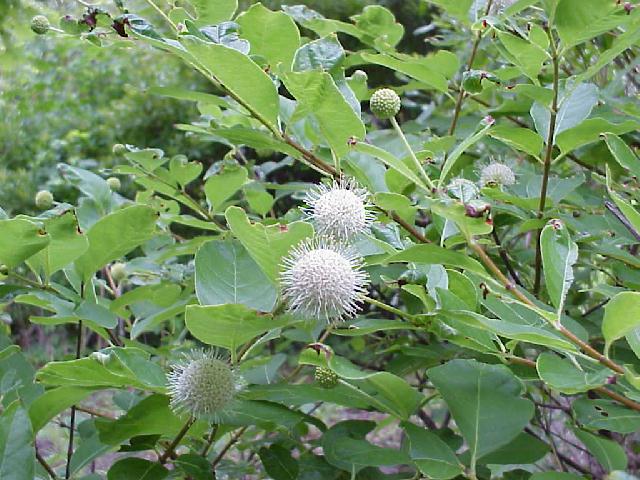
Weird-looking but spectacular are the blooms on Cephalanthus occidentalis, usually referred to as the Buttonbush. The blooms are perfectly round balls or spheres!


Buttonbush is native to the Eastern United States and as far west as Texas. Although you might have never seen one, when found growing naturally, it is usually on the bank of a pond or stream. Close friends of mine have a pond in West Point, Georgia, that is almost completely surrounded with large Buttonbush plants. Such a beautiful sight it is, when in bloom with all the pollinators buzzing around it.

This native shrub absolutely loves water and likes having wet feet all the time, but it can be grown in ordinary garden soil too. Buttonbush is very easy to grow and tolerates almost any soil. Heavy clay is not a problem at all.

The flowers are fragrant, and like many blooms favored by pollinators, smell like honey.

Leaves are dark green and shiny. I have not noticed any pest or disease problems with the buttonbush. This shrub leafs out late, sometimes not until May here in Georgia. The leafs turn a soft yellow in fall before dropping.

Cephalanthus occidentalis will reach heights up to 7 feet or more, and will do so quickly in wet soil.

Plant Buttonbush in full sun or partial shade on a pond or stream bank if you are lucky enough to have one on your property. If not, plant it where you can reach it with a hose on a regular basis. Mine are planted by the greenhouse where I can water it whenever I think it needs it.

Buttonbush will grow in any soil. Regular garden soil is fine. Whatever you have--Heavy to average soil. Clay soil is fine. But amend it with some composted manure or compost to add fertility. 

Cephalanthus occidentalis loves water. Keep soil moist to wet. This shrub even tolerates standing water. Don’t allow to dry out. 

Bumblebees love Blooms on the Buttonbush
The Buttonbush can be grown almost anywhere in the United States, since it is hardy in USDA Zones 4 – 10.

If you want a whole row of them or plan to plant in mass, space them about 5 feet apart.

Buttonbush benefits from being cut back severely every few years to rejuvenate the plant.


Plant a buttonbush in your garden and the bumblebees and butterflies will certainly thank you! I have seen 2 or 3 bumblebees on one flower all at the same time.

June Blooms in my Georgia Garden: Climbing Hydrangea

Every time I walk behind the greenhouse this time of year, I notice the distinct fragrance of honey. I wish you could smell it. This honey scent comes from the blooms of the large Decumaria barbara plant completely covering the pine tree it climbs. This fragrant Wild Hydrangea Vine can grow up to 30 feet!

Decumaria barbara is usually referred to as Climbing Hydrangea because its delicate, lacy blooms do look like a white hydrangea bloom cluster, and it is in the hydrangea family. This plant is also known as Wood Vamp, but I have been unable to figure out why. If you know, I would welcome your comments. 

Decumaria is a native vine found growing mostly in the Southeastern United States and can often be found on a hike through the woodland in Georgia. It can be grown anywhere in the South, since it is hardy in USDA Zones 7-11.

Do not confuse this plant with the non-native Hydrangea anomala petiolaris, which is also known as Climbing Hydrangea.

Wild Hydrangea Vine is easy to grow and can be grown as a groundcover or allowed to climb any structure. Like some other flowering vines, this Hydrangea Vine will not bloom unless it is permitted to climb. Its aerial roots will attach itself to anything from a tree trunk to a brick or rock wall, but will not damage the tree or wall in any way.

Decumaria barbara prefers part shade and is one of the few native vines that will bloom in full shade. The fact that it is usually found growing along stream banks indicates that it enjoys moist soil.

The rich green leaves look beautiful all summer and are not bothered by any pests or diseases. I would suggest it to be grown on an arbor or trellis near the patio, but it is deciduous in our climate, so there would be no foliage in winter.

Climbing Hydrangea belongs in the wildlife garden. Birds and small mammals love to hide and build nests in the lush foliage. Butterflies and other pollinators love the flowers.

State Wildflower of Georgia: Native Azalea

Since 1979, the native azalea has been the official state wildflower of Georgia. A certain variety was not chosen since several different species occur naturally in every county in Georgia.

Native azaleas are a member of the rhododendron family and are deciduous shrubs. Most varieties of these wild azaleas have highly fragrant blooms. Bloom color is spectacularly diverse and can be white, pink, yellow, orange, red, or any combination of those colors. With several species planted, you can have blooms in your garden from March all the way through August. 

These wild azaleas naturally occur in the woods, but they will often flower much more profusely when planted in full sun. Some species cannot take direct sunlight, but most varieties can tolerate morning sun or filtered sun beneath tall deciduous hardwood trees.  Beneath large oak trees is an ideal location for native azaleas, since the fallen oak leaves contribute to an acid soil favored by all azaleas.

Native rhododendrons will become more drought tolerant once established, but water regularly the first few years. 

Well-drained soil is necessary for the survival of all azaleas, but Rhododendron viscosum, commonly referred to as the Swamp Azalea, can grow in wetter soil where it will receive ample water to grow large and full.

Rhododendron viscosum


The early spring blooming native azaleas form their bloom buds in late summer, right when Georgia is usually experiencing a drought. To insure that you have fragrant blooms to enjoy in March and April, water your azaleas weekly during August and September unless it is raining regularly. 

A very popular native azalea species is Rhododendron Austrinum, the Florida Flame Azalea.  The Florida Azalea is prized for its colorful fragrant blooms appearing in early March. This is one of the easiest wild azaleas to grow, since it tolerates heat and drought once established. 

Rhodendron austrinum


If pink is your color, you have more than one choice. Most often seen in the woods of Georgia is the Piedmont Azalea, Rhododendron canescens. This wild azalea is also easy to grow and will eventually become a large specimen. Bloom color on this one can actually vary on individual plants though, and you might end up with flowers that are more white than pink.


That is also true of Rhododendron colemanii, the Red Hills Azalea. Native to the Red Hills of Alabama, this azalea can also be found growing wild near the Chattahoochee River in Georgia. Blooms on this one can be white, pink, yellow, or orange. 


As you can see in the photo above, the Red Hills Azalea can have both yellow and pink on the same plant. If you prefer a pink bloomer on either the Piedmont or the Red Hills Azalea,  choose your plants in spring when they are in bloom.

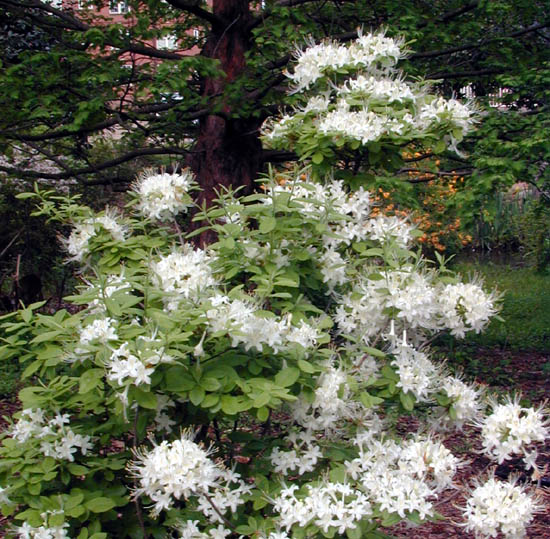
For a white garden, you have several choices. In addition to the Swamp Azalea, you might choose either the Sweet Azalea or the Alabama Azalea for fragrant white flowers. Rhododendron arborescens is often considered to have the loveliest flowers of all. Solid white blooms are deliciously fragrant, which is probably the reason for its common name of Sweet Azalea. 

The Alabama Azalea, Rhododendron alabamense, can be found growing in Georgia as well. White blooms with a bright yellow blotch smell like lemons. This wild azalea is very drought tolerant once established, making itself at home on dry rocky slopes in Alabama and Georgia. Even if summer drought kills the topgrowth, this shrub will usually send up new stems from the roots the next spring.

Alabama Azalea

One of the more difficult to grow native azaleas is also one of the most beautiful. Made famous by Callaway Gardens is the red blooming Plumleaf Azalea, Rhododendron Prunifolium. This plant occurs naturally only in a few counties in Georgia and Alabama in the Chattahoochee River Valley. Blooms are a vivid red or orange red. The Plumleaf Azalea needs a spot in the garden more shaded and cool. Rhododendron prunifolium wants no direct sunlight whatsoever. Don't forget to water this one during periods of drought or you'll lose it. 

Rhododendron Prunifolium, Plumleaf Azalea

The most common problem with growing native azaleas is actually finding some available for sale in the first place.  Most varieties of wild azaleas are either protected or endangered, so it is unlawful to dig them from the wild for transplanting in your garden. Online nurseries are a great source for native plants of all kinds, including native azaleas. A good selection of these fragrant native azaleas and many other native plants can be found at Shady Gardens Nursery.

June Blooms in my Georgia Garden: Oakleaf Hydrangea

This time of year our garden is always bursting with blooms, but this year has been a little different. Due to a very mild winter, everythin...