Showing posts with label garden. Show all posts

June Blooms in my Georgia Garden: Oakleaf Hydrangea

This time of year our garden is always bursting with blooms, but this year has been a little different. Due to a very mild winter, everything bloomed much earlier than usual. Plants that normally cover themselves with blooms in June began blooming in May. Oakleaf Hydrangeas are particularly beautiful this year. I believe they all have a bloom cluster at the end of each and every stem.

I have never seen the species Hydrangea quercifolia in my garden so beautiful as they are now. I dug these from my brother's property in Beulah, Alabama.

Snowflake Hydrangea is gorgeous with its pure white double bloom clusters. This plant always reminds me of my good friend Laura who was with me when I purchased it. Laura suffered from cancer that was overtaking her body. Time spent with her was precious. We spent the day touring Wilkerson Mill Gardens in the little town of Chattahoochee Mills, Georgia. The kids loved it, as did we. We bought several plants that day, which have thrived in our garden. So if you get a chance to see the garden and nursery there, I highly recommend it.

Hydrangea quercifolia 'Alice' has sprawled all over the place and will have to be cut back for rejuvenation. However, her blooms are large and fragrant. The fragrance was a surprise to me, but now I understand why the bees love Alice Hydrangea so much.


November Blooms in my Georgia Garden: Pink Muhly Grass

Pink Muhly Grass at Callaway Gardens
when my Children were small
The most beautiful of all the ornamental grasses to me is Muhlenbergia capillaris, usually called Pink (or Purple) Muhly Grass.

When not blooming, Pink Muhly Grass just disappears into the background. No one would notice it at all. But in late Summer or early Fall when the pink to purple seed heads develop, all I can think is WOW! 

Usually Pink Muhly Grass comes into bloom in September but is blooming much later this year, I'm guessing due to the drought. The plants are just now in full bloom. Everything has behaved differently this year. As I wrote in my last post, we've had no rain in our Georgia garden in more than two months. None. 

That just goes to show you what a tough plant this is. Most ornamental grasses are truly easy to grow, requiring nothing special in the way of soil or water. But most ornamental grasses just don't appeal to me. I love flowers.

Pink Muhly Grass gives me the look of flowers in the big beautiful fluffy clouds that look like cotton candy held high above the foliage. When in bloom, Pink Muhly Grass can be in excess of 3 feet tall. This plant is truly spectacular in the Fall garden.  And by the way, Muhlenbergia capillaris comes in White too. What I mean is there is white blooming form, but to me it is not so eye-catching.

Muhlenbergia is a clumping grass so it will not spread all over your garden. It is a very well-behaved plant native to the Eastern United States, and is hardy in USDA Zones 5-10. 

Muhly Grass also attracts beneficial insects. I'm not sure why, but ladybugs like it. 

Muhlenbergia capillaris needs very well-drained soil, so I recommend mixing in some compost when you plant it. And although it is drought tolerant once established, water it weekly during its first Summer in your garden.
 
Pink Muhly Grass is spectacular enough to be a specimen plant, but I like the drama of a large mass of them, if you have the space. It is particularly lovely if you can plant at the top of a hill where it will be backlit by the sun.

November Blooms in my Georgia Garden: Sasanqua Camellia

Right in the middle of the Fall harvest season not much thought is given to flowers. This is the time when our homes and front porches are decorated with hay bales, pumpkins, and scarecrows.  Fall or Autumn is my favorite season for many reasons, and I love decorating with the usual harvest items like pumpkins and gourds. But I still want to see flowers in my garden.

Sasanqua Camellias give me just that. Available in many bloom colors, Sasanquas bloom reliably in the Fall every year. 

I’ll never forget the first time I saw a Camellia in bloom. I was young, and I was new at gardening. I was driving through a residential area when I noticed a large, bushy, green shrub with large red blooms that looked like roses. Believe it or not, it took me a while to find out what it was! You’re probably laughing at me now, but thank goodness I’ve learned a few things about camellias since then. 

It wasn’t until attending the Master Gardener Course that I learned of the Sasanqua Camellia. Sasanquas are early bloomers, usually blooming October – December, so there is less chance of frost damaging the blooms. The fall blooming Sasanquas make great holiday decorations and gifts. Sasanqua camellias seem to be faster growing and are often larger growing than Japonica. Dwarf Sasanquas are available too--great for small gardens or even containers. Some varieties bloom so profusely that the blooms hide the foliage! 

Sasanqua Camellias prefer a sheltered site away from drying winter winds. The blooms are more delicate than those of Japonica Camellias. Bright, filtered shade beneath tall trees is ideal. Moist, well-drained soil is best, but camellias are drought tolerant once established. 

Although our garden has received no rain in over 8 weeks and Troup County is under a severe drought , the Sasanquas are beginning to bloom anyway. 

Remember that deer will eat the blooms on all camellias, so consider using a deer deterrent around them. Your local Humane Society or Animal Shelter has plenty of inexpensive deer-deterrent—the all-natural kind. Just ask the attendant which dogs are frisky enough for deer control! 

October Blooms in my Georgia Garden: Spider Lily, Lycoris radiata

Lycoris radiata is most often referred to by one of its common names. We always called them Spider Lilies, but in other parts of the South, it is known as Hurricane Lily, since it blooms at the height of Hurricane Season. Each summer we are plagued here in Georgia with a drought that goes on for weeks (if not months), and in September we'll finally get a drenching rain. It is after that good soaking rain that Spider Lilies pop up in old gardens of the South. This year, we did not receive that soaking rain at all, so the Spider Lilies finally bloomed without it--in October.


Lycoris radiata blooms have extremely long anthers that give them a "spider-like" appearance, hence the common name Spider Lily. Once the flowers fade, dark green basal leaves appear that look much like liriope (or "monkey grass", as it usually called around here.) Its leaves will stay green all winter here in Georgia, absorbing nutrients from the sun to convert into energy for the next summer's blooms.

Lycoris radiata is hardy only in the Deep South, in USDA Zones 7-10, but it is still easy to grow. Like other members of the Lycoris family, it tolerates any soil in either sun or shade and needs no supplemental water to thrive. 


I have only the red blooming Spider Lily, but it also can be found in white. I'm still looking for some.


All species of Lycoris should be divided or transplanted only when dormant, so as not to interrupt its bloom and growth. Early summer is the optimum time for this task. Once the foliage has withered, it is safe to dig the bulbs.

Lycoris does extremely well beneath large established trees.

The flowers make excellent cut flowers and hold up well in a vase, lasting for several days in a floral arrangement. 

And one more thing: Deer won't eat your Spider Lilies!

May Blooms in my Georgia Garden: Oakleaf Hydrangea


Oakleaf Hydrangea
 in Late Spring at Callaway Gardens
I know I've written this many times, but the Oakleaf Hydrangea is my very favorite hydrangea, for several reasons. Hydrangea quercifolia, commonly called the Oakleaf Hydrangea, is beautiful all the time.  

In summer, large blooms appear that attract much attention. The panicles of white blooms appear in May. These creamy white blooms can be quite large, depending on the cultivar. Blooms on 'Alice' can be up to 12 inches long, which makes for a spectacular display.


Late Summer Blooms
at LaGrange College
By late summer the white blooms change to a rosey purplish pink, hanging on into fall. 

In fall, the leaves turn a rich mahogany red, contrasting beautifully with the then dried rosy brown flower stalks used by many in floral arrangements. 

Oakleaf Hydrangea Fall Foliage
 at Shady Gardens Nursery

In winter, the branches exhibit lovely cinnamon colored exfoliating bark, and the large flower buds already forming are attractive. In spring, the new leaves are a reddish purple. So you see, Oakleaf Hydrangea is truly beatiful in every season!


Hydrangea quercifolia is much easier to grow than other hydrangeas. The fact that it is native to the southeastern United States is probably the reason for that. It’s accustomed to our summer droughts, making it more drought-tolerant than other hydrangea. It isn’t picky about soil. And Oakleaf Hydrangea can take more sun than most other hydrangeas.


Oakleaf hydrangea is one of our most beautiful American native shrubs, and should be in every garden.

May Blooms in my Georgia Garden: Mock Orange

Philadelphus coronarius
Sweet Mock Orange or English Dogwood
Blooms are spectacular this year on my Philadelphus coronarius, most often referred to as Sweet Mock Orange or English Dogwood. Our established shrub is completely covered with the fragrant dogwood-like white blooms.

Philadelphus coronarius is a deciduous shrub that grows quickly into a large shrub, so give it plenty of room. 

Because of our very mild winter, Mock Orange bloomed a little earlier than usual this year. Usually blooming in late May, the Mock Orange reached its peak bloom the first week of May here in our Georgia garden.

The white flowers with 4 petals smell like orange blossoms, hence the common name Mock Orange and resemble blooms on the Dogwood Tree. Leaves are tender and dark green. On the Sweet Mock Orange, even the bark is lovely, which is exfoliating and orange-tinged. 

This large growing shrub will eventually be up to 12 feet tall and just as wide with a rounded habit, so it's perfect at the edge of the property. 

Philadelphus coronarius can be grown in full sun to light shade, but ours is in pretty much full shade here in Georgia. It might get a little peak of morning sun, but I don't think so. 

Although rich fertile soil is best, our soil is hard clay, and our large shrub gets no supplemental water. This year we received more than enough rain during the Winter and Spring, which might be why our plant showed out so well this time.

Mock Orange is a popular old-fashioned shrub in the Southeastern states, and although it might look delicate, it can be grown in most of the United States, since it is hardy in USDA Zones 4-7.

If you want a hedge of Mock Orange, for Summer privacy perhaps, space them about 5 feet apart for good screening. The shrubs will quickly grow to fill the space. 

If pruning is needed, do so immediately after blooming by removing old canes at the base and cut back remaining branches to create a rounded shape. If your space allows it, don't prune your Mock Orange at all. 

March Blooms in my Georgia Garden: Fruit Shrubs and Trees

Before we can feast on the fruit from our growing collection of fruiting shrubs and trees, we get to enjoy the flowers. Some of the prettiest flowering trees in the South are fruit trees. 

Blueberry Flowers
Blueberry Bushes have cute little white blooms in clusters that attract pollinators. Blueberry Shrubs are all-around attractive, really. In Spring you have the blooms against newly developing blue-green leaves. In mid-spring the blueberry fruits develop, beginning as green drupes that gradually ripen into dark blue juicy fruits loved by people and wildlife. Attractive foliage remains until Fall when leaves turn all shades of orange, red, and burgundy. Some or all foliage remains into winter, depending on the temperatures of that particular winter or which part of the country you are in. Blueberry Bushes are gaining in popularity as the word gets out about how nutritious the fruit is and how easy the shrub is to grow. Homeowners are even incorporating Blueberry Bushes into their flower beds and foundation plantings. I've seen a few local businesses adding Blueberries to their commercial landscaping. How exciting!

Crabapple Trees have been used in landscaping for years. The flowers are beautiful, covering the tree canopy with loads of flowers in various shades of pink. But many Crabapple Trees produce a fruit that is not only loved by wildlife but edible for humans as well. 

Peach Trees are not known for being easy to grow. Some maintenance is required. But when you bite into that beautiful peach and feel the juice running down your chin, you know it was worth all that work. 

Plum Trees are beloved by children everywhere. We love to eat the plums either green or ripe, if we can get to them before the squirrels do. 

Our Ponderosa Lemon tree is huge. Originally purchased as a Meyer Lemon, this tree produces huge lemons that have a rough, knotty skin that is very thick. The fruit is very sour and the juice is great for a marinade. When I looked up recipes to decide what to do with the abundant fruits, I found that ours was not a Meyer Lemon after all, but a Ponderosa. Oh well, I'll keep looking for the hardy Meyer Lemon I guess.
Nanking Cherry in Bloom

Our newest fruiting plants are the Bush Cherry or Nanking Cherry. Not usually grown around here, the Nanking Cherry Bushes are growing well, and we are getting lots of fruit from them this year. These bushes will grow to be about 10 feet tall and just as wide, and they produce a small red cherry that is tart and delicious. 

We have other new fruit trees that haven't yet bloomed or produced fruit, and I intend to add as many new fruiting plants as I can until I run out of room.

March Blooms in my Georgia Garden: Japanese Magnolia

One of the showiest trees in our Spring garden is the Japanese Magnolia. Also known as the Saucer Magnolia or the Tulip Tree, this magnolia is a multi-stemmed spreading tree that often looks more like a very large shrub. 

The white, pink or purple blooms are very fragrant and appear in early Spring, usually in March. Large fuzzy flower buds are formed in winter and will begin opening  as early as February during a prolonged warm spell. 

Japanese Magnolia is easy to grow, but it loves moisture, so water it deeply during Summer droughts. Plant your tree in full sun for the showiest bloom.


March Blooms in my Georgia Garden: Bridal Wreath Spiraea


One of the earliest shrubs to bloom in our Georgia garden is Bridal Wreath Spiraea. The variety we grow is S. cantoniensis ‘Lanceolata’, which is absolutely covered with double blooms that look like tiny white roses. The blooms appear all along the stem, also resembling stems of Baby's Breath, which is common of floral arrangements. I have used Bridal Wreath stems similarly in my floral arrangements when the shrub is in bloom. 

Bridal Wreath Spiraea is very easy to grow. For the showiest bloom, plant in full sun where the large-growing shrub has plenty of room to grow. The arching stems will ultimately reach up to 6 feet tall and just as wide.

This spiraea can be grown in most parts of the United States, as it is hardy in USDA Zones 5-9b. 

Spiraeas are known to be very drought tolerant, and the one in our roadside garden gets no supplemental water at all. The soil in that bed is very hard clay.

January Blooms in my Georgia Garden: Winter Honeysuckle

A beautiful day in the garden can be had here in Georgia. One of the things I love most about living in Georgia is our mild winters. Yes, I know it has been bitter cold some days, which can be unbearable for us cold-natured gardeners. But on those nice sunny warm winter days, I love to walk in the garden. A few shrubs are blooming now in my garden. 

One of them is Winter Honeysuckle. Lonicera fragrantissima is covered with small but deliciously fragrant flowers that begin opening anytime from late January to early February. And when I walked outside yesterday afternoon, I found Lonicera fragrantissima in full bloom. This variety of Lonicera is known as Winter Honeysuckle since it blooms reliably every Winter. This old-fashioned shrub is also known as Kiss Me at the Gate.

Although I have received emails telling me Winter Honeysuckle is invasive, we have not found that to be so in our area. I have verified this with my favorite nurseryman. A large shrub will not make more than a couple of seeds, and there are no known areas that have been hugely populated with this lovely shrub. 

An old-fashioned shrub you probably won't find in your local garden center, Lonicera fragrantissima is worth grabbing up if you find one. I'm not sure why it is not widely grown, since it is so easy to propagate and grow.

Winter Honeysuckle is somewhat evergreen here in Georgia, depending on the winter. But the best thing is that Winter Honeysuckle blooms in Winter. The small flowers are very fragrant.

Lonicera fragrantissima grows very large, reaching a mature height and width of 6 feet or more. This lovely shrub tolerates a wide variety of conditions: sun, shade, dry, moist, cool, or hot. Winter Honeysuckle should be more widely available.

September Blooms in my Georgia Garden: Hibiscus mutabilis, Confederate Rose

One of the most requested plants in our garden is the Confederate Rose. You will probably never find this plant in a big box store, and it's hard to find it in any nursery. Yet, this elusive old Southern plant is a favorite of many gardeners.


Confederate Rose is not really a rose, but a Hibiscus, Hibiscus mutabilis, to be exact. 


The blooms of the Confederate Rose are voluptuous, like one might expect from a flower in the South. Although single flowers are out there, I have seen only the many-petaled, double blooming variety that opens light pink and gradually changes to a deep rose-pink on the third day after opening. It is the changing of the bloom color that gives the plant its botanical name, Hibiscus mutabilis. Blooms can be up to 6 inches across. All those petals remind me of the many fluffy layers of the petticoats worn by Southern belles of antebellum times here in the Southeastern United States.


Despite their popularity and ability to thrive in the Southeastern US, Confederate Rose is not native to the South but comes from China. They thrive in the South anywhere that they have time to open their very late flowers before fall frost. This species is a popular passalong plant. 


Height varies from about 8 to 15 feet and the plant grows wider every year (kind of like me, apparently.)


Confederate Rose is an eye-catching foliage plant even before bloom, with large, soft, gray-green maple shaped leaves. 


Like all plants in the Hibiscus family, Confederate Rose grows best in full sun with regular water, but it will bloom quite happily in part shade. This is true especially in areas with very hot temperatures lingering into its bloom time of late summer and early fall. Although this Hibiscus does love water, it can withstand periods of drought that is common in the Southeast.


Confederate Rose will grow in regular garden soil, but it will grow larger and develop more blooms in good fertile soil. 


Once winter frosts burn back the foliage, the entire plant can be cut back to make the garden more tidy. This can be done any time during the winter or early spring. Near the coast, you can let the stems stay if you don’t mind the plant becoming very large. Confederate Rose will resprout from current branches where winters are mild. However, the plant will become 10 feet tall by summer’s end, even when cut back the previous season.  Make sure to plant it where it has plenty of room to spread out.

August Blooms in my Georgia Garden: Chelone, Turtlehead

Georgia heat has been brutal this summer, but since I have a sprinkler with a timer, the Chelone is blooming on schedule. 

Chelone is an American native plant found in the Northeastern United States, but it grows nicely here in the Southeast if it gets enough water. Chelone is also known as Turtlehead. The flower spikes are made up of individual flowers that do resemble a turtle's head. According to Greek mythology, Chelone was a nymph who refused to attend the marriage of Zeus to Hera. As punishment, the gods turned her into a turtle!

Sometime in late August or September, depending on your climate, spikes of flowers ascend in either pink or white.

Chelone loves consistently moist or wet soil beside a pond or a stream. It is perfect for a bog garden. I have mine planted in a large tub that is my makeshift bog garden. Turtlehead can be grown in regular garden soil if you have irrigation. Chelone will bloom well in either partial shade or full sun, but if you put it in full sun, be ready to water it regularly. Amend your soil with a rich humusy compost and mulch with shredded leaves. A lot of shade promotes legginess, so if growing in shade, pinch the stems back in early summer to encourage stronger stems and more flowers. 

If you live in Maryland, Chelone is a necessary perennial for the butterfly garden, since it is an important food source for the Baltimore Checkerspot Butterfly, Maryland's State Insect.

This plant can be grown in most of the United States, since it is hardy in USDA Zones 5-8.

When in bloom, Chelone makes quite a show at a height and spread of up to 4 feet. Plant a low groundcover beside it that will remain green in the winter, because Chelone disappears completely with the first frost.

Deer Resistant? Yes! Deer will not eat Chelone. 

Chelone blooms make great cut flowers too, so plant it in your cutting garden.  Like most plants I write about, Chelone is available from my favorite native plant source, Shady Gardens Nursery.

May Blooms in my Georgia Garden: Caldwell Pink Rose

One of the showiest roses in my garden today is the Caldwell Pink Climbing Rose. Considered to be one of the "found" roses, Caldwell Pink is a polyantha that might be the same rose as Pink Pet from China. Caldwell Pink Climbing Rose blooms here in May each year, and when it does, it'll knock your socks off. The plant is absolutely covered with large clusters of small 2-inch fluffy pink blossoms. It is a rampant grower that will quickly cover a fence or arbor, rooting wherever it touches the ground. Although the blooms have very little fragrance if any, this is one of my favorites. Unfortunately, we won't see the blooms again until next year, since Caldwell Pink Climbing Rose is not a repeat bloomer.

Not so with the Caldwell Pink Shrub Rose. The shrub form of Caldwell Pink blooms continuously until the first Fall frost. Unlike the climber, Caldwell Pink Shrub Rose is a compact bush about 4 feet tall, so it is perfect for the small garden or in a foundation planting.

Whether you choose the climber or the shrub, Caldwell Pink Rose is very easy to grow. It tolerates the heat and drought common in our Georgia garden during the summer, Caldwell Pink can be grown in colder climates too, hardy in USDA Zones 6 through 10. The foliage remains clean and vibrant green throughout the season, never requiring spray chemicals of any kind. 

What's Blooming in my Georgia Garden in March?

Camellia Lady Vansittart
March is almost over, and the Camellias are still blooming. With this old-fashioned Southern favorite, one can have blooms in the garden from Fall all the way to Spring. Camellia Lady Vansittart has been blooming for more than a month in front of my home with Northwestern exposure. Yesterday I noticed red double blooms remaining on a couple of large camellias that came to me with no label many years ago.

Japanese Quince Toyo-ishiki


Flowering Quince is one of my favorite shrubs for the late winter garden. Texas Scarlet began blooming a few weeks ago with its bright red blooms. Toyo-nishika is an eyecatching shrub with blooms of white, pink, orange, and red all on the very same plant. All I can say is "Wow!"


Loropetalum Zhuzhou
Loropetalum never ceases to amaze me. Loropetalum is a Chinese Fringe Shrub that blooms several times throughout the year. Also known as Chinese Witch Hazel, you can see the similarity in bloom to our native Witch Hazel. Often here in Georgia, just as the shrubs get ready for their first (very early) Spring bloom, a late freeze will turn the buds brown before we can enjoy them. Loropetalum shrubs don't give up though and will form more blooms to try again just a little later. This has been a great year for the Loropetalum. Every one we have is just covered with brilliant hot pink blooms! There's a white-blooming Chinese Fringe shrub too.
White Chinese Fringe Bush


Native Redbud

Redbud is one of my favorite native trees. The largest one I have planted itself right in the middle of the path to the arbor next to my greenhouse. Of course, I did what any native plant freak would have done, and I moved the path, not the tree. That little seedling has grown several feet tall in just a few years. I knew she'd be thankful to me for not disturbing her.

Crabapple


The Crabapple Trees I have were bought several years ago from a nurseryman who is no longer living. I don't remember the cultivar, but the leaves are purple and the blooms are hot pink. In fall, small red apples develop, but the birds and squirrels quickly devour every one of them.


Creeping Phlox


Creeping Phlox is absolutely gorgeous on a slope or spilling over a rock wall. I have tried growing this tough little groundcover to spill over the brick retaining wall beside our driveway. But these pesky chickens (whom I love very much) won't let me have anything planted there. So far they've destroyed creeping phlox, loropetalum pixie, oregano, and ice plant in that spot. I have managed to keep some Lamb's Ear there by surrounding it with rocks. Wish me luck on that. But if you don't have free-range chickens roaming around in your garden scratching up your plants, Creeping Phlox will thrive for you, wherever you plant it. There's a fragrance too!


Bridal Wreath Spirea is spectacular this year. This shrub is completely covered with pure white blossoms that look like tiny white roses. Spireas are surprisingly easy to grow. I don't think this one has ever received any water other than rainfall. It's growing in full sun on a bank in our roadside garden with clay soil as hard as a brick.

What's Blooming in my Georgia Garden in February: Part 2

Well, it's still February, and now there are even more flowers in our Georgia garden. From my point of view, our weather has been horrible. A few beautiful sunny days warm enough to work outdoors have been sandwiched between lots of rainy cold days amidst dark and dreary cloudy days when the dampness just goes to my bones.

Fragrant Winter Daphne from Shady Gardens Nursery
Daphne odora, Fragrant Winter Blooms


If I were a shrub, I would not bloom, and if I were a flower, I would not open. Yet camellias and Daphne shrubs continue to bloom despite all this yucky weather.


Lonicera fragrantissima


And when I walked outside yesterday afternoon, I found Lonicera fragrantissima in full bloom. This variety of Lonicera is known as Winter Honeysuckle since it blooms reliably every Winter. This old-fashioned shrub is also known as Kiss Me at the Gate.
Spirea Fujino Pink

Then I remembered that Fujino Pink Spirea had bloomed earlier this month, and I forgot to mention that in my previous post.

 "Are they still blooming?" I wondered. Yes, yes, they are! 

Now I know what I must do. Since our winter weather can sometimes be too cold and wet for me to venture outdoors, I must plant some of these winter bloomers near a window, to be enjoyed from inside where it is warm!

Butterflies and Tips for a Butterfly Garden

Butterflies are probably everyone’s favorite garden creature. They are beautiful, mysterious, and romantic. It’s a goal of many gardeners to attract these lovely butterflies into the garden.

Butterflies need just 3 things: Water, a nectar source, and host plants on which to lay their eggs.

Water
All living creatures need water. The preferred source of water for butterflies is a mud puddle. This can be easily created by filling a large clay saucer with clean sand. Place this in a sunny spot in your butterfly garden and keep it moist at all times.

Butterfly on Buttonbush

Food Source - Nectar for Adult Butterflies
Nectar plants are the food source for adult butterflies. You’ll need Butterfly Bush of course, which is now available in many colors. Lantana can’t be beat for attracting butterflies. Clethra is a large-growing shrub that produces sweetly scented flower spikes up to 6 inches long in either pink or white and attracts butterflies by the hundreds. You'll enjoy the fragrance as well, which reminds me of fresh honey. Clethra, also known as Summersweet and Sweet Pepper Bush requires moist soil and full to partial sun. Joe Pye Weed comes in many forms. Helianthus is another late-blooming flower that butterflies love—it has large yellow sunflower-type blooms on tall stems. Of course all the beneficial insects, including butterflies, love Blackeyed Susan, Gaillardia (Blanketflower). In September, butterflies are attracted to Stonecrop (Sedums like Autumn Joy, Matrona, and Vera Jamison.) Dianthus flowers just about all summer, and butterflies are particularly attracted to this plant. You can fill in between bloom times of the perennials with annuals like cosmos, marigolds, and zinnias. 

Fennel is a Host Plant for Butterflies
Food Source for offspring (a place to lay eggs) - Host Plants 
Host plants are those on which butterflies lay their eggs. Yes, the larva will eat the plants, but without a place for the babies to grow into the beautiful adult butterfly, you can’t have the butterflies! So plant extra parsley, dill, fennel, and milkweed, so you can have plenty to share with the butterflies. An added bonus is that these plants also attract many other beneficial insects!
 
I did say that butterflies need just 3 things, however there is a 4th thing that is the most important of all: Never use pesticides in your garden. Using pesticides would kill the butterflies you are trying to attract. Use insecticidal soap instead.

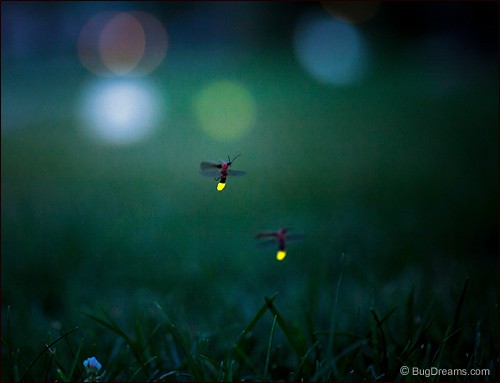
Lightning Bugs, Fireflies: Beneficial Insects for the Garden

We call them lightning bugs, but in some parts of the country they’re known as fireflies. Whatever you call them, we all enjoy seeing them flitting around and lighting up on summer nights. 

Photinus pyralis image from focusingonwildlife.com
Many of us enjoyed catching them and placing them in a lidded jar on our nightstand when we went to bed at night, but did you know that lightning bugs are beneficial insects? 

Lightning bugs are actually beetles that have a soft outer shell instead of a hard one. Lightning bugs lay their eggs in soft mud. Maybe that’s why we have so many this year—if you’ve been out to our place, you’ve seen our mud! 

It’s the larvae that are so helpful to gardeners—eating pests like snails, slugs, cutworms, and other larval pests. The larvae are luminous as well, lighting up all the time, but turning off their light when disturbed. For this reason they’re called Glow-worms. 

Researchers are also studying lightning bugs because they contain two rare chemicals that are used to fight cancer, multiple sclerosis, cystic fibrosis, and heart disease. So next time you’re sitting outside enjoying a warm summer evening, think about the wonderful little lightning bugs and all the other benefits God is providing for us in nature!

Fragrant Swamp Azalea: Rhododendron viscosum


If you like fragrant plants, you'll want Rhododendron Viscosum in your garden! Most often referred to as Swamp Azalea, Rhododendron Viscosum is a native azalea found in the Eastern United States. Pure white blooms in early summer have a pleasing spicy scent reminiscent of cloves. 
Rhododendron viscosum in June

Swamp Azalea, as the name implies, is one of the few azaleas that can tolerate periodically wet soil. This plant can grow in regular garden soil, but it does not want to miss out on water. If you can water regularly when rainfall is absent, Swamp Azalea will be easy for you to grow in your garden. Grows into a very tall shrub when planted near a pond or stream. Swamp Azalea is the perfect native rhododendron for a rain garden.

Rhododendron Viscosum can be grown almost anywhere in the United States since it grows well in USDA Hardiness Zones 4-9. 

Swamp Azalea can be grown in full sun if regular water is available. Otherwise, filtered sun/shade is best.

Camellia, the State Flower of Alabama

Although Alabama's State Flower is the Camellia, this popular Southern shrub is native to Asia. The first Camellias were brought to Charleston, South Carolina, in the late 1700's by the French botanist Andre' Michaux. Camellias are one of my favorite winter blooming plants. Camellias are often thought of as the Rose of Winter. There are thousands of different types of camellias, but most often what you see falls into one of two categories: Japonica and Sasanqua.

Camellia Japonica has glossy evergreen leaves and large blooms that may be any shade of white, red, or pick. Some even have "variegated" blooms that are spotched or striped. Blooms which can sometimes be very large come in several forms: single, double, semi-double, or peony type. Flowers hold up well indoors. I like to display them in a clear glass bowl.

Sasanqua Camellias have glossy evergreen foliage too, but the Sasanqua has different characteristics. Blooms are looser and appear more delicate, but the plant itself seems easier to grow. Sasanquas tolerate more sun that the Japanese Camellia, and they grow faster and larger too. 

By having a variety of both Japanese and Sasanqua Camellias in the garden, one can have blooms from Fall all the way into Spring. All camellias prefer some shade. Morning sun is okay, but give your camellias some protection from hot afternoon sun. They are all surprisingly drought tolerant once established, but you'll need to water regularly the first few years to get your shrubs established.

A good reference book to add to your collection would be Camellias: The Gardener's Encyclopedia, by Jennifer Trehane.

Although I do love camellias, personally, I think the State Flower should be one that is native to that state. But that's just me. What do you think?

June Blooms in my Georgia Garden: Oakleaf Hydrangea

This time of year our garden is always bursting with blooms, but this year has been a little different. Due to a very mild winter, everythin...