Showing posts with label Rhododendron. Show all posts

Late Summer Blooms for the Georgia Garden

By the end of summer, many plants have grown tired of providing blooms for our garden. Sometimes it can be a challenge to find plants that will fill in this difficult time with flowers. A diligent gardener can find quite a few plants that bloom in late summer. 

You’re probably familiar with Black-eyed Susan and Butterfly Bushes, providing the garden with blossoms this time of year no matter how hot it gets, attracting butterflies by the hundreds. You’ve seen Japanese Honeysuckle on the side of the road, or perhaps you’re even plagued with its invasive qualities in your own garden. 

But have you seen our native Red Trumpet Honeysuckle? Lonicera sempervirens is a non-invasive evergreen vine that blooms almost year round, attracting hummingbirds, butterflies, and many other beneficial insects. Grow it as a groundcover, let it climb an arbor or trellis, or train it to cover a fence. You’ll be rewarded with blooms from spring to fall, and I’ve even seen blooms on mine in December! It will grow in sun or shade, but flowers more profusely in full sun. 

For the shade, try Lobelia cardinalis, our native red Cardinal Flower, loved by hummingbirds. This perennial prefers moist soil, but can be grown in regular garden soil with supplemental water. 

If you have a woodland garden, try the beautiful Plumleaf Azalea, an American native azalea made famous by Callaway Gardens. Rhododendron prunifolium is a rare deciduous azalea with bright red blooms in late July and August. Plumleaf Azalea prefers a cool shady spot with regular water. 

Perennial hibiscus continues to offer up showy blooms in several colors right up until the onset of cold weather. 

And for a little later on in the season, consider adding Swamp Sunflower, a good companion for perennial hibiscus, since they both share a love for sun and water. Helianthus blooms in September with large, bright yellow flowers on tall stems up to 10 feet tall! 

I hope you’ll try some of my suggestions in your late summer garden as you strive to make your garden more beautiful year round.

April Blooms in My Georgia Garden: Week 2

Piedmont Azalea

Piedmont Azalea, Rhododendron cansescens, is a native azalea found in the Piedmont region of Alabama and Georgia. This plant has many common names. Piedmont means "foot of the mountain" which is where this native azalea is usually found. Hoary or Wooly Azalea is another common name, coming from the hairs in the tubes of the flowers. Sweet Mountain Azalea has to be because of the sweet fragrance of the blooms on this azalea that enjoys growing in the mountains. This shrub is often called Wild or Bush Honeysuckle, because the blooms look and smell like those of the honeysuckle vine. There are a few other common names which I cannot understand. But this is one plant that belongs in your garden.

Florida Flame Azalea
Blooms on the Florida Flame Azalea, Rhododendron austrinum, can be just as varied as those of the Piedmont Azalea. Flowers on the Florida Flame Azalea, as the common name suggests, are the colors of a flame and can be anywhere from pure yellow to pure orange, or anywhere in between. This one has flowers that are reddish orange and yellow. Florida Flame Azalea lights up the garden when in bloom. Although the native azaleas naturally occur in the shade of a woodland, Florida Flame azalea will bloom much more profusely when grown in full sun. By the way, although as its name implies, Florida Flame is native to the state of Florida, but you might not ever see it growing wild there. This deciduous Azalea is rare and endangered, so purchase it from a native plant nursery.


Lonicera sempervirens John Clayton


Our John Clayton Honeysuckle, a named cultivar of the native wild honeysuckle, Lonicera sempervirens, is showing out early too--ahead of the species known as Coral or Red Trumpet Honeysuckle.  The native honeysuckle is just as easy to grow as Japanese Honeysuckle, but it is not invasive, and this vine will not plant itself all over your whole neighborhood.


Viburnum Korean Spice


Viburnum carlesii Korean Spice blooms are beautiful--round flower clusters in the snowball arrangement consist of pink buds that open into white flowers with a yellow center. I wish computers had a "scratch and sniff" feature, because the Korean Spice Viburnum has a wonderful fragrance.  Like most viburnums, Korean Spice will grow very large over time, up to about 6 feet tall and just as wide. It is lovely at the back of the flowerbed or in a mixed shrub border. In Fall, the foliage turns a brilliant red and bright red berries develop. Here in Georgia, give this shrub partial sun, and it will grow very well for you.

Fragrant Swamp Azalea: Rhododendron viscosum


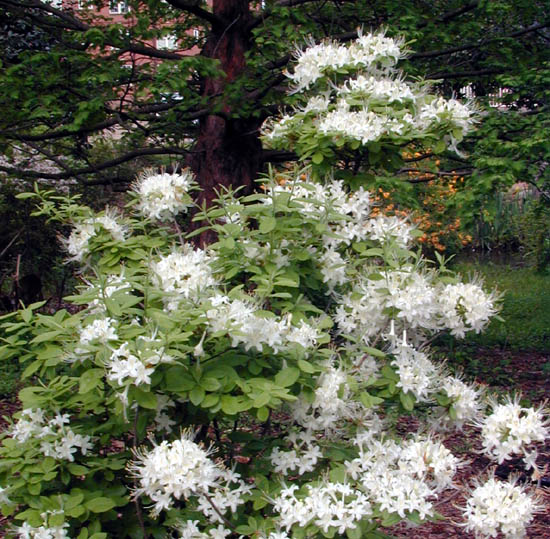
If you like fragrant plants, you'll want Rhododendron Viscosum in your garden! Most often referred to as Swamp Azalea, Rhododendron Viscosum is a native azalea found in the Eastern United States. Pure white blooms in early summer have a pleasing spicy scent reminiscent of cloves. 
Rhododendron viscosum in June

Swamp Azalea, as the name implies, is one of the few azaleas that can tolerate periodically wet soil. This plant can grow in regular garden soil, but it does not want to miss out on water. If you can water regularly when rainfall is absent, Swamp Azalea will be easy for you to grow in your garden. Grows into a very tall shrub when planted near a pond or stream. Swamp Azalea is the perfect native rhododendron for a rain garden.

Rhododendron Viscosum can be grown almost anywhere in the United States since it grows well in USDA Hardiness Zones 4-9. 

Swamp Azalea can be grown in full sun if regular water is available. Otherwise, filtered sun/shade is best.

Chapman's Rhododendron: Rare Evergreen Native Shrub

Rhododendron Chapmanii, Chapman's Rhododendron
Evergreen Rhododendron Native to Florida
The rarest rhododendron of all might also be the most beautiful! I have grown native azaleas in my garden for years, but I did not even know an evergreen native rhododendron existed until recently.

The beautiful green foliage has a reddish tint in early Spring.

Rhododendron Chapmanii is the only evergreen rhododendron native to Florida, and actually there are only a few evergreen species of rhododendron native to the United States. 

Chapman's Rhododendron is very rare, and is probably the most rare of all wild rhododendrons in North America. This rhododendron is an endangered species, so if you are lucky enough to find some growing wild, it is illegal to dig them up or disturb them in any way.

The beautiful rose pink flowers appearing in Spring are exquisite. The blooms are borne in clusters and look like bouquets on the tips of the branches.

Chapman's Rhododendron occurs naturally only in Florida, but it can be grown anywhere in USDA Zones 5b - 8.

Rhododendron Chapmanii prefers dappled shade beneath pines or hardwoods. 

All rhododendrons need well-drained soil, but Chapman's Rhododendron will need regular water.

I would not give it much direct sun. Afternoon sun would burn the lovely green foliage. 

To obtain this rare native plant for your garden, please visit Shady Gardens Nursery.


Oconee Azalea: Rhododendron Flammeum


We are very excited about the newest plant to our garden this year. Oconee Azalea is a deciduous native azalea with brightly colored blooms in several different hues. I have spent several years searching for this shrub.

Since it is unethical and often illegal to dig plants from the wild, we have been looking for a wholesale source for this plant in order to also offer it to other native azalea lovers.

Rhododendron Flammeum, formerly known as Speciosum, is commonly referred to as the Oconee Azalea and the Flame Azalea. Flammeum is a deciduous azalea native to the Piedmont region of Georgia and South Carolina.

Also often called the Flame Azalea, Rhododendron Flammeum displays bright flame-colored blooms in brilliant shades of apricot, coral, pink, orange, red, or yellow. Sometimes different shades even appear on different branches of the same shrub!

This species is all about variety. Not only can bloom color vary greatly, but growth habit can differ from one plant to another.  The Oconee Azalea ranges from a low mounding shrub to a tall tree-like form of 6  feet or more.

Blooms are not fragrant and appear usually sometime in April, after the Piedmont (Canescens) but before the Swamp and Alabama Azalea.

Flammeum can tolerate summer heat in gardens of the Deep South.

Hardiness: USDA Zones 6 – 9.

Site:  Part shade or filtered sunlight. High shade beneath tall hardwoods & pines is ideal.

Moisture: Regular water is best for optimum blooms and growth for year round beauty. Most azaleas are drought tolerant once they've been in the garden a few years.

Soil: Well-drained soil on the acidic side is important for all azaleas and rhododendrons. Amend the planting soil with compost or soil conditioner at planting time, especially if you have clay soil.

*Mulch well to retain moisture and keep the roots cool.  Azaleas have shallow roots close to the surface of the soil, so do not cultivate the soil after planting. 

A low groundcover beneath azaleas serves two purposes. Not only does a colorful groundcover accent the azalea, but also it will help to discourage weed growth. 

For more information on the Oconee Azalea as well as many other species Rhododendrons, please visit Shady Gardens Nursery.

Plant Azaleas in Fall instead of Spring!


Rhododenderon Canescens, Piedmont Azalea
Native Azaleas are definitely a spectacular show in Spring, but don't wait till Spring to plant them! Shrubs planted in Fall have a much better chance to get established and become healthy plants by next summer. 

The American Native Azaleas, species Rhododendrons, are deciduous, meaning they lose their leaves for the winter. This defoliation begins quite early in fall, depending on the climate conditions and the variety. Usually the earlier the bloom time in spring, the earlier leaf loss occurs in Fall.  

Fall is the best time to transplant shrubs because they are then dormant. Fall planted shrubs have all winter to become established before time to bloom and grow next year. This is especially important when your plants are received by mail, as is most often true with rare plants like native azaleas.

When planting native azaleas, soil preparation is key. All azaleas prefer well-drained soil. Amend the soil for drainage, especially if your soil is clay.  Prior to planting your native azalea, work in some compost or composted manure and shredded bark to the planting hole. To help insure good drainage, mound up the soil so your azalea is planted high. Be sure that the root collar is slightly higher than soil level so water will drain away when those heavy downpours occur.
 
When planning your native azalea garden, consider the site. Native azaleas naturally occur in the filtered light beneath large trees near stream banks, but will grow in full sun when water is adequate.  They perhaps will bloom more profusely in full sun, but need more water with more sun. 

Make sure you can get water to the plant if drought occurs. Native azaleas are quite drought tolerant once established, however, water weekly the first year or two, as the plant grows in to its new environment.  Also, the blooms buds are formed during late summer on the early blooming varieties, and if your area is prone to a late summer-early fall drought, pay attention to those weekly waterings, so you won’t miss out on your fragrant Spring blooms! 

Finally, obtain some good organic mulch. Azaleas have a shallow root system. Apply a thick layer of any organic mulch such as shredded bark, leaves, or pine straw to conserve moisture and keep the roots cool. Never cultivate around your native azaleas, since this can damage those shallow roots. 
Once planted, your native azaleas will need water at least once weekly to insure good root development and beautiful blooms for years to come. 

For more information on the beautiful and fragrant native azaleas, visit us at Shady Gardens Nursery.

State Wildflower of Georgia: Native Azalea

Since 1979, the native azalea has been the official state wildflower of Georgia. A certain variety was not chosen since several different species occur naturally in every county in Georgia.

Native azaleas are a member of the rhododendron family and are deciduous shrubs. Most varieties of these wild azaleas have highly fragrant blooms. Bloom color is spectacularly diverse and can be white, pink, yellow, orange, red, or any combination of those colors. With several species planted, you can have blooms in your garden from March all the way through August. 

These wild azaleas naturally occur in the woods, but they will often flower much more profusely when planted in full sun. Some species cannot take direct sunlight, but most varieties can tolerate morning sun or filtered sun beneath tall deciduous hardwood trees.  Beneath large oak trees is an ideal location for native azaleas, since the fallen oak leaves contribute to an acid soil favored by all azaleas.

Native rhododendrons will become more drought tolerant once established, but water regularly the first few years. 

Well-drained soil is necessary for the survival of all azaleas, but Rhododendron viscosum, commonly referred to as the Swamp Azalea, can grow in wetter soil where it will receive ample water to grow large and full.

Rhododendron viscosum


The early spring blooming native azaleas form their bloom buds in late summer, right when Georgia is usually experiencing a drought. To insure that you have fragrant blooms to enjoy in March and April, water your azaleas weekly during August and September unless it is raining regularly. 

A very popular native azalea species is Rhododendron Austrinum, the Florida Flame Azalea.  The Florida Azalea is prized for its colorful fragrant blooms appearing in early March. This is one of the easiest wild azaleas to grow, since it tolerates heat and drought once established. 

Rhodendron austrinum


If pink is your color, you have more than one choice. Most often seen in the woods of Georgia is the Piedmont Azalea, Rhododendron canescens. This wild azalea is also easy to grow and will eventually become a large specimen. Bloom color on this one can actually vary on individual plants though, and you might end up with flowers that are more white than pink.


That is also true of Rhododendron colemanii, the Red Hills Azalea. Native to the Red Hills of Alabama, this azalea can also be found growing wild near the Chattahoochee River in Georgia. Blooms on this one can be white, pink, yellow, or orange. 


As you can see in the photo above, the Red Hills Azalea can have both yellow and pink on the same plant. If you prefer a pink bloomer on either the Piedmont or the Red Hills Azalea,  choose your plants in spring when they are in bloom.

For a white garden, you have several choices. In addition to the Swamp Azalea, you might choose either the Sweet Azalea or the Alabama Azalea for fragrant white flowers. Rhododendron arborescens is often considered to have the loveliest flowers of all. Solid white blooms are deliciously fragrant, which is probably the reason for its common name of Sweet Azalea. 

The Alabama Azalea, Rhododendron alabamense, can be found growing in Georgia as well. White blooms with a bright yellow blotch smell like lemons. This wild azalea is very drought tolerant once established, making itself at home on dry rocky slopes in Alabama and Georgia. Even if summer drought kills the topgrowth, this shrub will usually send up new stems from the roots the next spring.

Alabama Azalea

One of the more difficult to grow native azaleas is also one of the most beautiful. Made famous by Callaway Gardens is the red blooming Plumleaf Azalea, Rhododendron Prunifolium. This plant occurs naturally only in a few counties in Georgia and Alabama in the Chattahoochee River Valley. Blooms are a vivid red or orange red. The Plumleaf Azalea needs a spot in the garden more shaded and cool. Rhododendron prunifolium wants no direct sunlight whatsoever. Don't forget to water this one during periods of drought or you'll lose it. 

Rhododendron Prunifolium, Plumleaf Azalea

The most common problem with growing native azaleas is actually finding some available for sale in the first place.  Most varieties of wild azaleas are either protected or endangered, so it is unlawful to dig them from the wild for transplanting in your garden. Online nurseries are a great source for native plants of all kinds, including native azaleas. A good selection of these fragrant native azaleas and many other native plants can be found at Shady Gardens Nursery.

Rhododendron My Mary: Fragrant Yellow Azalea


Rhododendron 'My Mary' is a new plant for me. Aside from the large and very fragrant yellow blooms appearing in April, the romantic story behind the name compelled me to plant this one.

'My Mary' is a deciduous hybrid azalea--a cross between Rhododendron Nacoochee and Rhododendron Austrinum (the native Florida Flame Azalea.) As written above, the blooms are large and very fragrant--a beautiful yellow funnel-shaped flower with an orange tube. The flowers are borne in clusters, or bouquets, as I like to call them. As you might imagine, pollinators of every sort just love them!

Rhododendron 'My Mary' was developed by the well-respected Mr. George Beasley of Lavonia, Georgia, who named this plant after his wife, Mary. She must indeed be lovely, to have such a plant named in her honor. I'm proud to have this shrub in my humble garden.

Hardy in USDA Zones 5-8, this deciduous rhododendron can be grown almost anywhere in the United States.
Culture is the same as for just about any other rhododendron or azalea: well-drained soil with a nice addition of humus, regular water (weekly is great), partial shade, and a thick layer of mulch to protect the roots.
For more information on this plant, you may contact us at
Shady Gardens Nursery or consult the Missouri Botanical Garden Plantfinder, who so graciously permitted us to use their lovely photos.

June Blooms in my Georgia Garden: Oakleaf Hydrangea

This time of year our garden is always bursting with blooms, but this year has been a little different. Due to a very mild winter, everythin...