Showing posts with label blooms. Show all posts

June Blooms in my Georgia Garden: Oakleaf Hydrangea

This time of year our garden is always bursting with blooms, but this year has been a little different. Due to a very mild winter, everything bloomed much earlier than usual. Plants that normally cover themselves with blooms in June began blooming in May. Oakleaf Hydrangeas are particularly beautiful this year. I believe they all have a bloom cluster at the end of each and every stem.

I have never seen the species Hydrangea quercifolia in my garden so beautiful as they are now. I dug these from my brother's property in Beulah, Alabama.

Snowflake Hydrangea is gorgeous with its pure white double bloom clusters. This plant always reminds me of my good friend Laura who was with me when I purchased it. Laura suffered from cancer that was overtaking her body. Time spent with her was precious. We spent the day touring Wilkerson Mill Gardens in the little town of Chattahoochee Mills, Georgia. The kids loved it, as did we. We bought several plants that day, which have thrived in our garden. So if you get a chance to see the garden and nursery there, I highly recommend it.

Hydrangea quercifolia 'Alice' has sprawled all over the place and will have to be cut back for rejuvenation. However, her blooms are large and fragrant. The fragrance was a surprise to me, but now I understand why the bees love Alice Hydrangea so much.


November Blooms in my Georgia Garden: Salvia greggii

One of the most reliable bloomers in my Georgia garden is Salvia greggii, Autumn Sage. Living up to its common name, this little woody perennial that grows more like a small shrub is still in full bloom after Thanksgiving this year. Autumn Sage is nearly evergreen in our West Central Georgia climate, often blooming on into December and sporadically throughout the winter. Bright red blooms attract hummingbirds and other pollinators to the garden. The aromatic foliage is not devoured by deer.

My first Autumn Sage was given to me by the horticulturists at Hills and Dales Estate when I was a volunteer there. They were very generous to the Troup County Master Gardeners, often giving us plants we admired when we worked there. Some of my favorite plants came from their lovely historic gardens.  

The blooms of Salvia greggii are most often red or some shade of red, but thanks to breeding programs, can now be found in pink, orange, and even white. 


Autumn Sage is not bothered by disease or pests, including deer. This plant doesn't even want fertilizer unless it's growing in a container for an extended period of time.

Salvia greggii is native to the state of Texas, but grows well all over the Southeast and can be grown in most parts of the United States. Autumn Sage is hardy in USDA Zones 5 through 9.  This salvia makes a fine specimen or hedge plant in flower or shrub border. It can be pruned to a certain height and is easily kept to 2 or 3 feet tall. Salvia greggii is an excellent xeriscape plant, adapting well to rocky, sandy, and poor soil as long as it is well-drained. Supplemental water is usually not necessary, even in dry and drought-prone areas. Full sun is the only requirement of Autumn Sage.

A lovely companion for Autumn Sage is the Mexican Bush Sage, Salvia leucantha.

March Blooms in my Georgia Garden: Creeping Phlox

Blooms are everywhere today in my Georgia garden. After such a mild winter, everything is blooming much earlier than normal. Creeping Phlox is absolutely gorgeous on a slope or spilling over a rock wall. I have tried growing this tough little groundcover to spill over the brick retaining wall beside our driveway. But these pesky chickens (whom I love very much) won't let me have anything planted there. So far they've destroyed creeping phlox, Loropetalum 'Pixie', oregano, and ice plant in that spot. I have managed to keep some Lamb's Ear there by surrounding it with rocks. Wish me luck on that. But if you don't have free-range chickens roaming around in your garden scratching up your plants, Creeping Phlox will thrive for you, wherever you plant it. There's a fragrance too!

November Blooms in my Georgia Garden: Osmanthus fragrans, Sweet Tea Olive

Osmanthus fragrans
I've been anxiously awaiting the blooms on my Tea Olives ever since Fall arrived. We've been under a severe drought here in Georgia for a couple of months now. Most of our plants are suffering, and many have refused to bloom. Some established shrubs and trees might even die. 

But there she is, my Tea Olive, blooming anyway. I admit, the blooms are not as plentiful as usual, but they are still there, and I can smell their sweet fragrance. 

Osmanthus fragrans is one of my favorite evergreen shrubs. When in full bloom, my whole garden smells like fresh apricots! 

Osmanthus fragrans 'Fudingzhu'
I must say Osmanthus fragrans is one of the easiest plants to grow. This evergreen shrub grows very large over time and does well in full sun to part shade. Not picky about soil, the tea olive tolerates clay soil and is drought tolerant (once established.) 

The most sensational bloom is in fall, but Osmanthus fragrans blooms sporadically year round. The fragrance is most notable in the evening on warmer days. Blooms are so tiny that you'd never suspect the heavenly fragrance is coming from them!

An exception to that is Osmanthus fragrans 'Fudingzhu', which has showy clusters of the tiny blooms--still with that same sweet fragrance.

Osmanthus fragrans 'Aurantiacus'
Orange Blossom Tea Olive
Evergreen foliage is a rich green that holds up well in floral arrangements. 

Osmanthus fragrance is hardy in USDA Zones 8-11, but is often seen in Atlanta which is Zone 7. Can withstand temperatures down to 10 degrees with no foliar damage.

Although we have some blooms on the Osmanthus shrubs that have been in the garden several years, I fear the we'll see no blooms this year on our Orange Blossom Tea Olive, Osmanthus fragrans 'Aurantiacus.'

March Blooms in my Georgia Garden: Fruit Shrubs and Trees

Before we can feast on the fruit from our growing collection of fruiting shrubs and trees, we get to enjoy the flowers. Some of the prettiest flowering trees in the South are fruit trees. 

Blueberry Flowers
Blueberry Bushes have cute little white blooms in clusters that attract pollinators. Blueberry Shrubs are all-around attractive, really. In Spring you have the blooms against newly developing blue-green leaves. In mid-spring the blueberry fruits develop, beginning as green drupes that gradually ripen into dark blue juicy fruits loved by people and wildlife. Attractive foliage remains until Fall when leaves turn all shades of orange, red, and burgundy. Some or all foliage remains into winter, depending on the temperatures of that particular winter or which part of the country you are in. Blueberry Bushes are gaining in popularity as the word gets out about how nutritious the fruit is and how easy the shrub is to grow. Homeowners are even incorporating Blueberry Bushes into their flower beds and foundation plantings. I've seen a few local businesses adding Blueberries to their commercial landscaping. How exciting!

Crabapple Trees have been used in landscaping for years. The flowers are beautiful, covering the tree canopy with loads of flowers in various shades of pink. But many Crabapple Trees produce a fruit that is not only loved by wildlife but edible for humans as well. 

Peach Trees are not known for being easy to grow. Some maintenance is required. But when you bite into that beautiful peach and feel the juice running down your chin, you know it was worth all that work. 

Plum Trees are beloved by children everywhere. We love to eat the plums either green or ripe, if we can get to them before the squirrels do. 

Our Ponderosa Lemon tree is huge. Originally purchased as a Meyer Lemon, this tree produces huge lemons that have a rough, knotty skin that is very thick. The fruit is very sour and the juice is great for a marinade. When I looked up recipes to decide what to do with the abundant fruits, I found that ours was not a Meyer Lemon after all, but a Ponderosa. Oh well, I'll keep looking for the hardy Meyer Lemon I guess.
Nanking Cherry in Bloom

Our newest fruiting plants are the Bush Cherry or Nanking Cherry. Not usually grown around here, the Nanking Cherry Bushes are growing well, and we are getting lots of fruit from them this year. These bushes will grow to be about 10 feet tall and just as wide, and they produce a small red cherry that is tart and delicious. 

We have other new fruit trees that haven't yet bloomed or produced fruit, and I intend to add as many new fruiting plants as I can until I run out of room.

March Blooms in my Georgia Garden: Bridal Wreath Spiraea


One of the earliest shrubs to bloom in our Georgia garden is Bridal Wreath Spiraea. The variety we grow is S. cantoniensis ‘Lanceolata’, which is absolutely covered with double blooms that look like tiny white roses. The blooms appear all along the stem, also resembling stems of Baby's Breath, which is common of floral arrangements. I have used Bridal Wreath stems similarly in my floral arrangements when the shrub is in bloom. 

Bridal Wreath Spiraea is very easy to grow. For the showiest bloom, plant in full sun where the large-growing shrub has plenty of room to grow. The arching stems will ultimately reach up to 6 feet tall and just as wide.

This spiraea can be grown in most parts of the United States, as it is hardy in USDA Zones 5-9b. 

Spiraeas are known to be very drought tolerant, and the one in our roadside garden gets no supplemental water at all. The soil in that bed is very hard clay.

February Blooms in my Georgia Garden: Fujino Pink Spirea

One of the earliest shrubs to bloom in our Georgia garden is the lovely Spiraea thunbergii 'Fujino Pink.'

Fujino Pink Spiraea in February
Fujino Pink Spiraea is a beautiful, fine branched spirea that sports masses of pink buds along the stems which open to light pink flowers in late winter to early spring before the leaves emerge. This shrub is a soft, airy plant that looks great massed or as a hedge.

Some spiraeas (also often spelled 'spirea') grow very large, but this is one of the small ones maturing to about 4 feet high and wide, making it perfect for a small garden.

Spiraea thunbergii can be grown all over the United States, as it is hardy in USDA Zones 4 - 9.

For best flowering, grow spiraea in full sun, but we have quite a few that receive only part sun and bloom just beautifully anyway. That's typical for our garden, since summer sun can be too intense for delicate foliage.

Spiraes prefer well-drained soil with regular water, but Fujino Pink Spiraea is drought tolerant once established. As I've said before, no shrub is considered established until it has been planted at least a couple of years.


February Blooms in my Georgia Garden: Camellia Japonica

Yes, we have a camellia blooming just about all the time in our garden from September through April. Right now in the middle of February, we are enjoying the blooms on Camellia Japonica 'Lady Vansittart.' 

Also blooming now is 'Professor Sargent,' another Japanese Camellia.

Camellia Japonica, Japanese Camellia, is an evergreen shrub with large flowers in Fall or Winter, depending on species. There are so many different types of camellias that one can have blooms in the garden from September to April.

Japanese Camellia has glossy dark green leaves that can be up to 5 inches long. If on the underside of the leaves you notice specks that resemble black pepper, spray with insecticidal soap.

Blooms are also large and very showy. Some Japanese Camellias have flowers as large as 5 inches across. These camellias continue to bloom for up to 6 weeks. Flowers may be single, semi-double, or double, and some have ruffled petals or even variegated or striped blooms.

The plentiful blossoms hold up well in a vase for beautiful cut flower arrangements. 

Camellias are easy to grow. Choose a spot with dappled shade or morning sun with afternoon shade. However, some camellias can even tolerate full sun. 'Lady Vansittart' gets hot afternoon sun in our garden.

Camellias are drought tolerant once established. Here in Georgia, I have found that camellias planted before Christmas will do fine through the following summer. Camellias that didn't make it for us were those planted in Spring, so I don't advise Spring-planting for Camellias here in our hot climate.

Camellias like a rich soil, so at planting time, amend the soil with compost or soil conditioner. Water weekly if it doesn't rain, and your camellia will reward you with years of bloom at a time of year when not much else is blooming.

February Blooms in my Georgia Garden: Daphne odora

Despite all this crazy weather we've been having, Daphne odora is blooming right on schedule here in our garden.

Fragrant Winter Daphne…mmm—the fragrance is just lovely. If you’ve never had the pleasure of approaching a Winter Daphne shrub in bloom, just imagine a bowl full of fresh lemons, sliced, right beneath your nose. Scent descriptions vary for these very fragrant flowers. To me they smell like lemons but I've heard others describe the scent as that of Fruit Loops. The fragrance is very pleasing and not overpowering. The scent doesn't annoy even the most sensitive of noses. 

Daphne odora is a small evergreen shrub, reaching only 3-4 feet in height. This Daphne carries several common names. You might know it by Fragrant Daphne, February Daphne, or Winter Daphne. It is available with pink blooms or white and with straight green foliage or variegated. But all Daphne odora is both evergreen and very fragrant. Blooms come in either pink or white. 

The first time I saw it, we were at the Atlanta Botanical Gardens. It was so cute that we determined to find one for our own garden. That took a few years, actually. Daphne is hard to find in local nurseries and garden centers, probably because it has a reputation for being difficult to grow. Really, it isn’t, if you know what it likes. Daphne will not tolerate wet soil. It needs very little water. That can be a problem during times of drenching rains as we've had this winter. When it rains, our heavy clay soil will remain soggy, so amend the soil for drainage when you plant. Daphne prefers shady conditions, but can tolerate a little morning sun. The perfect spot would be beneath large trees on an incline for good drainage. Mix in some soil conditioner or compost and builder’s sand, and plant high—with the top of the root ball slightly above ground level. Then mulch well to conserve moisture and keep the roots cool. Water the shrub when you plant it, but don’t worry about watering it again. Can you believe it’s that easy? It is! If you live in the South, you are constantly looking for drought tolerant plants, and once you know about Daphne, it will be your favorite.

Daphne odora is a beautiful shrub even when not in bloom. The small rounded form of this evergreen shrub can fit into any garden. You simply must have one!

January Blooms in my Georgia Garden: Winter Honeysuckle

A beautiful day in the garden can be had here in Georgia. One of the things I love most about living in Georgia is our mild winters. Yes, I know it has been bitter cold some days, which can be unbearable for us cold-natured gardeners. But on those nice sunny warm winter days, I love to walk in the garden. A few shrubs are blooming now in my garden. 

One of them is Winter Honeysuckle. Lonicera fragrantissima is covered with small but deliciously fragrant flowers that begin opening anytime from late January to early February. And when I walked outside yesterday afternoon, I found Lonicera fragrantissima in full bloom. This variety of Lonicera is known as Winter Honeysuckle since it blooms reliably every Winter. This old-fashioned shrub is also known as Kiss Me at the Gate.

Although I have received emails telling me Winter Honeysuckle is invasive, we have not found that to be so in our area. I have verified this with my favorite nurseryman. A large shrub will not make more than a couple of seeds, and there are no known areas that have been hugely populated with this lovely shrub. 

An old-fashioned shrub you probably won't find in your local garden center, Lonicera fragrantissima is worth grabbing up if you find one. I'm not sure why it is not widely grown, since it is so easy to propagate and grow.

Winter Honeysuckle is somewhat evergreen here in Georgia, depending on the winter. But the best thing is that Winter Honeysuckle blooms in Winter. The small flowers are very fragrant.

Lonicera fragrantissima grows very large, reaching a mature height and width of 6 feet or more. This lovely shrub tolerates a wide variety of conditions: sun, shade, dry, moist, cool, or hot. Winter Honeysuckle should be more widely available.

Late Summer Blooms for the Georgia Garden

By the end of summer, many plants have grown tired of providing blooms for our garden. Sometimes it can be a challenge to find plants that will fill in this difficult time with flowers. A diligent gardener can find quite a few plants that bloom in late summer. 

You’re probably familiar with Black-eyed Susan and Butterfly Bushes, providing the garden with blossoms this time of year no matter how hot it gets, attracting butterflies by the hundreds. You’ve seen Japanese Honeysuckle on the side of the road, or perhaps you’re even plagued with its invasive qualities in your own garden. 

But have you seen our native Red Trumpet Honeysuckle? Lonicera sempervirens is a non-invasive evergreen vine that blooms almost year round, attracting hummingbirds, butterflies, and many other beneficial insects. Grow it as a groundcover, let it climb an arbor or trellis, or train it to cover a fence. You’ll be rewarded with blooms from spring to fall, and I’ve even seen blooms on mine in December! It will grow in sun or shade, but flowers more profusely in full sun. 

For the shade, try Lobelia cardinalis, our native red Cardinal Flower, loved by hummingbirds. This perennial prefers moist soil, but can be grown in regular garden soil with supplemental water. 

If you have a woodland garden, try the beautiful Plumleaf Azalea, an American native azalea made famous by Callaway Gardens. Rhododendron prunifolium is a rare deciduous azalea with bright red blooms in late July and August. Plumleaf Azalea prefers a cool shady spot with regular water. 

Perennial hibiscus continues to offer up showy blooms in several colors right up until the onset of cold weather. 

And for a little later on in the season, consider adding Swamp Sunflower, a good companion for perennial hibiscus, since they both share a love for sun and water. Helianthus blooms in September with large, bright yellow flowers on tall stems up to 10 feet tall! 

I hope you’ll try some of my suggestions in your late summer garden as you strive to make your garden more beautiful year round.

August Blooms in my Georgia Garden: Chelone, Turtlehead

Georgia heat has been brutal this summer, but since I have a sprinkler with a timer, the Chelone is blooming on schedule. 

Chelone is an American native plant found in the Northeastern United States, but it grows nicely here in the Southeast if it gets enough water. Chelone is also known as Turtlehead. The flower spikes are made up of individual flowers that do resemble a turtle's head. According to Greek mythology, Chelone was a nymph who refused to attend the marriage of Zeus to Hera. As punishment, the gods turned her into a turtle!

Sometime in late August or September, depending on your climate, spikes of flowers ascend in either pink or white.

Chelone loves consistently moist or wet soil beside a pond or a stream. It is perfect for a bog garden. I have mine planted in a large tub that is my makeshift bog garden. Turtlehead can be grown in regular garden soil if you have irrigation. Chelone will bloom well in either partial shade or full sun, but if you put it in full sun, be ready to water it regularly. Amend your soil with a rich humusy compost and mulch with shredded leaves. A lot of shade promotes legginess, so if growing in shade, pinch the stems back in early summer to encourage stronger stems and more flowers. 

If you live in Maryland, Chelone is a necessary perennial for the butterfly garden, since it is an important food source for the Baltimore Checkerspot Butterfly, Maryland's State Insect.

This plant can be grown in most of the United States, since it is hardy in USDA Zones 5-8.

When in bloom, Chelone makes quite a show at a height and spread of up to 4 feet. Plant a low groundcover beside it that will remain green in the winter, because Chelone disappears completely with the first frost.

Deer Resistant? Yes! Deer will not eat Chelone. 

Chelone blooms make great cut flowers too, so plant it in your cutting garden.  Like most plants I write about, Chelone is available from my favorite native plant source, Shady Gardens Nursery.

July Blooms in my Georgia Garden: Clethra, Summersweet, Sweet Pepper Bush

Clethra alnifolia 'Ruby Spice'
Blooming in the heat of summer with temperatures hovering near 100 degrees is Clethra alnifolia. Also known as Sweet Pepper Bush or Summersweet, Clethra attracts many pollinators with its honeyscented blooms of pink or white. Clethra is a deciduous blooming shrub native to the Eastern United States. I'm a little late with this post, since our Clethras all bloomed earlier in July and have now finished blooming.

Because I love all things pink, my favorite Clethra is Ruby Spice. Vivid pink bloom spikes adorn the tips of almost every stem in late July or August. Ruby Spice Clethra is a tall shrub, reaching up to 8 feet tall at maturity.

Clethra 'Hummingbird'
If you prefer white blooms, Clethra Hummingbird is a popular choice a lake at Callaway Gardens. 
Hummingbird Clethra encircles the edge of Hummingbird Lake behind the Discovery Center. This shrub has pure white bottlebrush blooms spikes about 3 inches long. The fragrant blooms which smell kind of spicy attract pollinators from a great distance.


Another white bloomer is Clethra Sixteen Candles, selected and named by horticulturist Michael Dirr from the University of Georgia. This Clethra is so named because when in bloom its upright flowers resemble candles on a birthday cake. These blooms are up to 6 inches long! Due to its compact habit, this one grows well in containers so it would be great on a patio or sunny porch where the blooms and their fragrance could be better enjoyed.
Clethra 'Sixteen Candles'

No matter the flower color, butterflies and bumble bees love the nectar produced by Clethra blooms. I'm watching to see if our honeybees visit the blooms too.

Clethra needs regular water to grow well. In its natural environment it is found growing on the banks of a creek or lake. Full sun makes the plant bloom prolificly in the latter part of summer. You'll want to be able to reach the plants with a hose when summer drought arrives. 

Clethra can be grown literally all over the United States, since it is hardy in USDA Zones 4 - 9.

June Blooms in my Georgia Garden: Button Bush

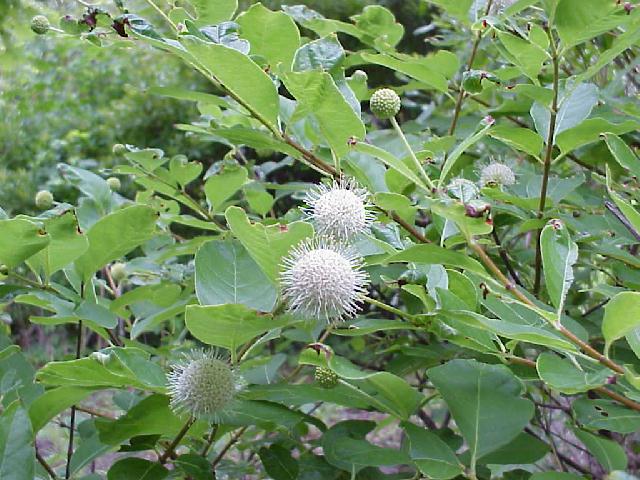
Weird-looking but spectacular are the blooms on Cephalanthus occidentalis, usually referred to as the Buttonbush. The blooms are perfectly round balls or spheres!


Buttonbush is native to the Eastern United States and as far west as Texas. Although you might have never seen one, when found growing naturally, it is usually on the bank of a pond or stream. Close friends of mine have a pond in West Point, Georgia, that is almost completely surrounded with large Buttonbush plants. Such a beautiful sight it is, when in bloom with all the pollinators buzzing around it.

This native shrub absolutely loves water and likes having wet feet all the time, but it can be grown in ordinary garden soil too. Buttonbush is very easy to grow and tolerates almost any soil. Heavy clay is not a problem at all.

The flowers are fragrant, and like many blooms favored by pollinators, smell like honey.

Leaves are dark green and shiny. I have not noticed any pest or disease problems with the buttonbush. This shrub leafs out late, sometimes not until May here in Georgia. The leafs turn a soft yellow in fall before dropping.

Cephalanthus occidentalis will reach heights up to 7 feet or more, and will do so quickly in wet soil.

Plant Buttonbush in full sun or partial shade on a pond or stream bank if you are lucky enough to have one on your property. If not, plant it where you can reach it with a hose on a regular basis. Mine are planted by the greenhouse where I can water it whenever I think it needs it.

Buttonbush will grow in any soil. Regular garden soil is fine. Whatever you have--Heavy to average soil. Clay soil is fine. But amend it with some composted manure or compost to add fertility. 

Cephalanthus occidentalis loves water. Keep soil moist to wet. This shrub even tolerates standing water. Don’t allow to dry out. 

Bumblebees love Blooms on the Buttonbush
The Buttonbush can be grown almost anywhere in the United States, since it is hardy in USDA Zones 4 – 10.

If you want a whole row of them or plan to plant in mass, space them about 5 feet apart.

Buttonbush benefits from being cut back severely every few years to rejuvenate the plant.


Plant a buttonbush in your garden and the bumblebees and butterflies will certainly thank you! I have seen 2 or 3 bumblebees on one flower all at the same time.

June Blooms in my Georgia Garden: American Elderberry

Large flat white flower clusters adorn each stem of the American Elderberry Bush at the edge of our garden today. Sambucus canadensis, known as the American Elderberry is a shrubby plant native to the Southeastern United States. This time of year you can spot the large bloom clusters on plants in ditches and moist spots along the roadside all over Alabama and Georgia. Perhaps you've noticed these large flowers on your commute to work or school and wondered what they are. 

The flower clusters provide nectar for all types of pollinators. When you examine the flowers up close, you find that they emit a nice honey scent into the air. Can pollinators smell that? If they cannot, I wonder how they find flowers that have the sweet nectar they want. 

The flower clusters are followed by small purple-black berries in late summer. The berries are adored by birds and make great wine. They do not taste good to me, but once my little boy ate so many that he vomited. The berries should be cooked before ingested. Little boys will eat anything and must be watched constantly, especially in the garden. I am fortunate that vomiting is the only thing he suffered that day. He is now 14 and since then has eaten very many things that horrify me, but that's a story for another day.


Elderberry loves water but is easy to grow in any garden. Sambucus spreads by suckers and reaches a height of 8-10 feet by the end of summer even if cut to the ground in early spring. Plant it at the back of the border or along the edge of your property, so the size will not be a problem. Looks particularly beautiful on the bank of a pond or stream, if you have one.

Sambucus canadensis can be grown just about anywhere in the United States, since it is hardy in USDA Zones 3-9.

Elderberry is not picky about its site, as it will grow great in either part shade or full soil, as long as soil is rich and water is plentiful. Well that's what it prefers, but I've found it will grow in regular soil where water is not plentiful, but just won't get as large, and will be quite leggy.

Whether you use the flowers and berries yourself or not, consider planting Elderberry in your garden. It is a great plant for wildlife.

May Blooms in my Georgia Garden: Pomegranate

Pomegranate Blooms
One of the showiest plants in my garden today is the Pomegranate Tree. As you can see, the large, fluffy many-petaled flowers resemble carnations. This cultivar is the very popular 'Wonderful.'

Exotic as it may seem, Pomegranates are very easy to grow in your own garden here in Georgia and Alabama. Pomegranates enjoy a hot dry summer even when planted in poor soil. In fact, Pomegranate just might be the easiest fruit tree to grow! 

Punica granatum, or as we know it, Pomegranate, loves hot sunny summers and dry, well-drained soil. It’s perfect for Georgia gardens, as long as we amend the soil for drainage. Pomegranate trees, or actually the growth habit is more like that of a shrub, require a cold winter to set fruit. That’s us—hot summers and a cold winter—at least cold enough for Pomegranates, because winter temperatures down into the 40’s is cold enough.

Pomegranate is a rapid growing plant that will ultimately be 10-20 feet tall. This large shrub can be somewhat prickly, so situate it where that won't be a problem. The large fruits are heavy, weighing down the branches.  It's best to prune the plant to keep it 10 feet or under, making it easier to pick the fruit and also to keep the branches from breaking with the weight of the fruit. 

The large fluffy bright orange blossoms appear in early summer. The fruit develops in late summer and matures into fall.  The foliage is attractive as well--new growth is red-tinged, and the leaves turn a golden yellow in fall.

With all the news lately regarding the health benefits of Pomegranate juice, we should all consider growing our own pomegranates!

April Blooms in My Georgia Garden

Well, today is April 2nd, and the garden is literally exploding with blooms. Most of the plants that bloomed in March are still in bloom, but new flowers are opening every day. Each time I go out, I find that another bud has opened. I sure do love Spring! Here's what's blooming in my Georgia garden today.

Kerria japonica Plena

Kerria, often called Japanese Thornless Rose, is a deciduous perennial that grows more like a large shrub. And I do mean large. The double-flowered Kerria Japonica 'Plena' beside the greenhouse is over 7 feet tall. It is covered with bright yellow blooms that resemble pompoms. Kerria likes regular water and will bloom quite well in shade, but this one receives morning sun. And as for water, it gets sprinkled every single day, since I must water daily all the container plants I have out there for sale. We also have the single blooming Kerria japonica 'Shannon', but it's still trying to get established, as it was planted just last year. I'm told there is a white blooming Kerria, which I have yet to obtain.


Lady Banks Rose is another early Spring blooming plant available in either yellow or white blooms. Lady Banks Rose blooms just once a year, but when she does, it is spectacular. Blooms on Lady Banks are smaller than the typical rose, but there are several flowers to a cluster, and when in bloom, one can hardly see the leaves for the flowers. Speaking of leaves, Lady Banks is mostly evergreen here in Georgia, losing most of her leaves only during severe winters. And unlike Kerria, which is truly thornless but not really a rose, Lady Banks Rose is a true thornless rose. As if that were not enough, Rosa banksiae is quite drought tolerant and will still bloom even when grown in a good bit of shade.


Fothergilla Mount Airy
Some of the cutest blooms in my garden are on the Fothergilla. We have the large Fothergilla major 'Mount Airy'. A common name is Witch Alder - I'm not sure why. Fothergilla enjoys regular water, so the one near my greenhouse has been growing rapidly. Fothergilla is a rare and endangered American native plant found in the mountains and piedmont areas of Alabama, Georgia, and Tennessee. We grow our own, or obtain some from a friend who also grows this wonderful plant. Blooms are white bottlebrush type flowers that are sweetly fragrant. I fall in love with Fothergilla again every Fall, when the leaves appear to light on fire with colors of yellow, orange, and red.


Leucothoe axillaris


Leucothoe is an evergreen shrub that would be lovely beside a creek or a pond, which I do not have...Leucothoe axillaris is planted near the fence, also near the greenhouse, where it can get plenty of water. This species will ultimately be about 4 feet high, which will be almost tall enough to hide that unattractive fence. Also known as Fetterbush, Dog Hobble, and Coastal Leucothoe, this shrub grows best in part sun with regular water. The blooms remind me of Lily of the Valley, as they are very fragrant white bell-shaped blooms that hang in clusters from the stem.


Illicium floridanum


Florida Anise is a large-growing evergreen shrub that is, as the common name suggests, a native of Florida. Every part of Illicium floridanum, Florida Anise, is fragrant--the blooms, the foliage, and the stems. I love any evergreen shrub that also blooms, but flowers on the Florida Anise are very unusual. Red, star-shaped flowers appear all over the bush in Spring and if the plant likes its location, sporadic blooms will appear on and off throughout the summer. This is another shrub that likes water. Our largest one is planted where I seldom water, so it pouts when the summer drought shows up, reminding me to stretch a hose out there. So last year, I planted another Florida Anise behind the greenhouse, where I run the sprinkler every day. I am excited to see how fast this little bush will grow. 


Vaccineum ashei

Blueberries are in full bloom too. I am tickled with the thought of how many blueberries we will have this year. This is one shrub that appreciates all the rain we've had. Bumblebees are all over the rabbiteye blueberries planted behind the greenhouse. It's hard to beat the birds to the berries. It helps to plant them in a high traffic area or an area where you spend a lot of time, so you can pick and eat blueberries as they ripen, before the birds have a chance to get them. It also helps to plant as many blueberry shrubs as you have the space for. That way you have enough berries to share with the birds and squirrels. Although I seldom see this, blueberries make an excellent foundation shrub. The shrubs will eventually be thick enough to provide a little privacy if planted around a porch or patio. Although blueberries don't need pruning to promote more fruit, they can be pruned to a certain size if necessary. Blooms are pretty, and in Fall, the leaves turn a burgundy red, adding to the beauty of the Fall landscape.

What's Blooming in my Georgia Garden in February: Part 2

Well, it's still February, and now there are even more flowers in our Georgia garden. From my point of view, our weather has been horrible. A few beautiful sunny days warm enough to work outdoors have been sandwiched between lots of rainy cold days amidst dark and dreary cloudy days when the dampness just goes to my bones.

Fragrant Winter Daphne from Shady Gardens Nursery
Daphne odora, Fragrant Winter Blooms


If I were a shrub, I would not bloom, and if I were a flower, I would not open. Yet camellias and Daphne shrubs continue to bloom despite all this yucky weather.


Lonicera fragrantissima


And when I walked outside yesterday afternoon, I found Lonicera fragrantissima in full bloom. This variety of Lonicera is known as Winter Honeysuckle since it blooms reliably every Winter. This old-fashioned shrub is also known as Kiss Me at the Gate.
Spirea Fujino Pink

Then I remembered that Fujino Pink Spirea had bloomed earlier this month, and I forgot to mention that in my previous post.

 "Are they still blooming?" I wondered. Yes, yes, they are! 

Now I know what I must do. Since our winter weather can sometimes be too cold and wet for me to venture outdoors, I must plant some of these winter bloomers near a window, to be enjoyed from inside where it is warm!

Edgeworthia, Rice Paper Plant: Fragrant Blooms for the Winter Garden

Edgeworthia chrysantha buds beginning to open
If you've been searching for something new, exciting, or unusual for your Winter garden, consider Edgeworthia. First of all, what could be more exciting than a plant that blooms in winter? No matter how cold it is outside, Edgeworthia will bloom in the middle of Winter. Plant it near a window so you can view the beautiful blooms from the comfort of your home. 

Edgeworthia's Winter blooms are not only beautiful, but are also fragrant. Scent is often described as being similar to that of the paperwhite narcissus. However, I find the fragrance to be more similar to cloves. On second thought, plant Edgeworthia near the entrance of your home, so you can enjoy the fragrance of the flowers when you come and go. Or perhaps you could do as I did and get more than one.

Edgeworthia grows wild in China and is related to Daphne odora, and has even been called Yellow Daphne. Also known as Rice Paper Plant, Chinese Paper Plant, and Japanese Paper Plant, Edgeworthia is used to make rice paper. 

There are several species of Edgeworthia, but the most desirable is Edgeworthia chrysantha, since it is more winter-hardy and easier to grow. Edgeworthia chrysantha is a deciduous shrub with very fragrant spherical bloom clusters in late January into February. A large specimen of Edgeworthia chrysantha can be seen growing at the Atlanta Botanical Garden.

Large elongated leaves are more than 3 inches wide and can be up to 11 inches long. The leaves which resemble plumeria, lend a tropical look to the garden in summer. Thus, edgeworthia contributes beauty and interest even when not in bloom. 

Silver buds form in late summer and early fall, growing larger and larger through the Fall, encouraging my anticipation and excitement. When the leaves are gone, the plant appears to be already in bloom. Then in early Winter, the buds begin to swell and resemble upside down sunflowers about 2 inches across. In mid- to late-Winter, the flower clusters begin opening from the outside in. Deep yellow tubular flowers attract pollinators who happen to be out on warmer days. In Georgia, Edgeworthia blooms in January or February, depending on the conditions for that particular Winter. Blooms last up to 6 weeks.

Edgeworthia chrysantha grows to about 6 feet tall and just as wide.

In China, Edgeworthia grows in full sun, but here in Alabama and Georgia, Edgeworthia chrysantha grows best in partial shade or filtered light. No hot afternoon sun.

Edgeworthia is hardy in USDA Zones 7-10, but Edgeworthia chrysantha tolerates colder temperatures and grows just fine in zone 6. 

Rich well-drained soil and regular water will keep your Edgeworthia plant happy. Be sure to water once or twice weekly during periods of summer heat and drought. Like hydrangeas, Edgeworthia will let you know when it is thirsty - the large leaves will droop and hang limp. With a good soaking of water, your plant will promptly perk up.

Edgeworthia grows rather quickly, and tends to send up new shoots from the base, forming a rounded shrub up to 6 feet tall. In Fall, leaves do turn yellow and fall off, but that just makes the plant ready to show off those extravagant Winter blooms. Attract attention and make your neighbors envious with this unusual and beautiful plant, Edgeworthia chrysantha.

June Blooms in my Georgia Garden: Oakleaf Hydrangea

This time of year our garden is always bursting with blooms, but this year has been a little different. Due to a very mild winter, everythin...