 |
| Merry Christmas, from our Family at Shady Gardens |
Christmas Trees: Is a Real Tree a Good Thing?

However, purchasing a cut Christmas Tree for your home can be a good thing for several reasons.
Many people are still out of work, and any time you purchase something grown here in the United States, you are helping provide jobs for American workers.
Most fresh cut Christmas Trees are from Christmas Tree Farms near you--farms that are owned by small business owners. Purchasing your tree from a Christmas Tree Farm near you helps to keep your neighbors in business! Local farm produce stands and locally owned garden centers often sell fresh cut trees or even potted ones you can plant to enjoy for years to come.
Christmas Trees are often grown on land that is unsuitable for other types of farming. The kinds of trees grown for Christmas trees can be grown on poor soil. By using these fields, tree farmers help to control erosion and provide year-round homes for wildlife.
One acre of Christmas trees produces enough oxygen for the daily needs of 18 people. (Trees absorb carbon dioxide and release oxygen.)
Trees help filter dust and smog from the air.
Christmas Trees are 100% biodegradable. There are several ways your tree can be used after the Christmas season is over. The tree can be ground into mulch for the garden, it can be moved to the edge of your property as a nesting area for small wildlife, or the branches can be cut small for use as firestarters.
On Christmas Tree farms, for every Christmas Tree harvested, usually up to three seedlings are planted in its place.
Choosing your tree at the local Christmas Tree Farm can be a very fun family outing!
So if you're in the market for a Christmas Tree this year, consider helping a local business owner by choosing a real cut Christmas Tree!
For more information about real tree farming, please visit Real Trees 4 Kids.
And for even more fun and interesting information, go to the
National Christmas Tree Association website where you'll find a link to help you find a Christmas Tree farm near you.

Christmas Tree for the Birds

Decorating for Christmas is a wonderful way to spend time together as a family. Once we get the inside of our house decorated each year, we try to involve the children in providing for our wildlife friends outdoors.
Decorating an outdoor tree for the birds is a great way to spend an afternoon. We use a cedar tree that happened to plant itself close to our dining room window, but any tree can be used, as long as you and your children can reach its branches. When you put your imagination to work, you can come up with all kinds of decorations made from things birds can eat. Materials can be berries, nuts, seeds, and breads along with natural items found outside like pinecones and sweet gum balls.
Fresh cranberries can be strung on cotton twine to be hung throughout the tree.
Using regular loaf bread, we used cookie cutters to to cut out shapes and a straw to poke a hole so we could use twine for hanging them on the tree. We then toasted the bread slightly to make it stiff before spreading with chunky peanut butter. A sprinkling of seeds makes the 'cookie' appealing to the birds. We looped cotton twine through the hole in the top and hung these from the tree.
Additional decorations were made using pinecones. We applied peanut butter to the pinecones before rolling them in birdseed.
Sliced apples and oranges and pineapple can be hung using twine.
A walk through the garden gave us more ideas. Nandina berry clusters made beautiful ornaments. Creampuff, one of our red hens, likes those.
Popcorn looks beautiful on the tree, but I'm surprised to find the birds are not eating that. The peanut butter toast was gone the next day, so we had to make more!
This is a Christmas tree that will be enjoyed by all types of wildlife, and watching to see who visits your tree is a great way for your children to learn more about nature.
Dry Fall in Georgia - Can I Plant Anything Now?
Well, folks, it certainly looks like we are in for a dry Fall here in Georgia. This really puts a damper on my Fall planting plans. Each year, I look forward to Fall, because this is the time of year that I can plant shrubs in the outer stretches of our garden. I cannot reach these parts of my garden with a hose, so I usually wait for rain to be in the forecast, and then I hurry out there with my shovel and shrubs. Earlier this week, according to our local meteorologist, we had a 20% chance of rain for today. I thought the day I had been waiting for was finally coming. Yesterday, that chance of rain was removed from our forecast. So far this Fall, I have been waiting, and waiting, and waiting for that rain that just has not come.
A rain shower every two or three weeks does not constitute regular rainfall that should be coming this time of year. I remember cold rainy days in October during my younger years. Back then, I did not enjoy that weather, because I had not yet discovered the joys of gardening. It seems like once I fell in love with plants and the gardening bug really bit me hard, the droughts came. And every single year I become more and more discouraged when I walk out into the garden.

Our soil looks more like bricks I could use to build a potting shed than something in which to plant a shrub. This is the result of record-breaking intense heat along with a drought that has been going on for years. While we did receive nice rain showers in Spring this year that stirred up my excitement, received rain never caught up with our need. We began summer with a rainfall deficit.
What will I do? The only thing I can do is wait for rain...
Drought Damage in my Georgia Garden
I took a walk in the garden today to assess the damage the drought has caused thus far. Many of the plants believed to be drought-tolerant have actually suffered quite a bit. I did find a few surprises when I noticed plants that still look great in spite of absolutely no water, so I thought I’d share them with you.
Lady Banks Rose has not wilted, although she's been in the ground only one year. I can’t reach her with the hose, so I was a little worried.
Other shrubs and trees with no wilt are: American Beautyberry, Holly, Paw Paw, Spirea, Arizona Cypress, and Rosemary.
Established camellias and viburnums look fine, while newly planted ones wilt again every few days and recover only after a deep soaking.
 |
| Mahonia from Shady Gardens Nursery |
Although it will plant itself in your garden wherever it likes, Leatherleaf Mahonia never wilts. It provides a rough texture in the garden with its tough evergreen spiny leaves and bright yellow winter bloom sprays followed by dark purple berries that are loved by songbirds. It requires shade. Although it does reseed freely, I do not consider it to be an invasive plant.
Perennials that still look great are Hosta, Rohdea, sedums, and succulents. Hardy Ice Plant is great for dry sun—rewarding you with flowers that open in full sun even with no rainfall.
If you decide to add any of these recommended plants to your garden during this drought, remember that no plant is completely drought tolerant the first year, so water weekly in the absence of rain. In other words, water weekly, because obviously, there is no rain!
Georgia Drought Monitor
I don't yet know what I can do with this information, but my despair prompted me to get online to find out if the drought is as serious as I think it is. I found this site which confirms my suspicions:
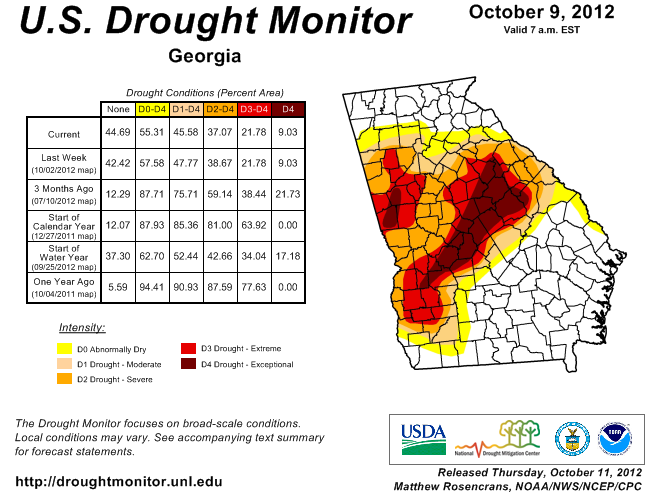
Troup County is where we attempt to garden. And sure enough there we are, right there in a section labeled extreme/exceptional. And the "exceptional" section fills up most of Troup County, so I can be sure that includes us. Upon closer examination, I found that yes, of course, we are in that spot. I didn't really need to see this, because I know when I look at the ground outside that we are suffering.
Fall
is my favorite time of the year. I just
love the cool, crisp air which makes walking in the garden so much more
enjoyable. I enjoy Fall gardening for the same reason—it’s cooler.
I am a
sucker for a fall-blooming plant. I’m
always on the lookout for something new, so I thought I’d share with you some
of my findings.
 |
| Pink Muhly Grass, Muhlenbergia Capillaris |
Pink Muhly Grass is hard to find, but when you see it, you’ll love the pink fluffy plumes that arise from the foliage in September. This plant is beautiful when planted in mass, but also makes a great specimen. Muhlenbergia capillaris is it’s botanical name, and this plant looks great with fall blooming asters.
 |
| Mistflower, Hardy Ageratum Eupatorium coelestinum |
Perennial Ageratum is another eye-catcher with its bright lavender blooms that return each year in September. Also known as Mistflower, this perennial is a member of the Eupatorium family. You might find it labeled Eupatorium Coelestinum. The blooms look just like the annual ageratum, but this plant returns reliably each year, as long as you can water it during dry periods. All plants in the Eupatorium family require moisture to thrive. Which might make you wonder why I included this plant in my list, but I couldn't help showing you these wonderful flowers behind the greenhouse. This spot does receive regular water from our sprinklers.
Berries tickle me as well, because I know they’ll bring birds into the garden. One of my favorites is American Beautyberry with its deep magenta berries that are in clusters wrapped around the stem. The berries hang onto the stems even after the leaves have dropped, providing interest on into the winter. If purple isn’t your thing, a rare white form and a pink form can be found in specialty nurseries.
 |
| American Beautyberry, Shady Gardens Nursery |
 |
| Tiny Flowers on Tea Olive perfume the Garden |
Well, I know it does not feel like fall outside here in Georgia today, but this is as much of a fall as we're likely to get. So while the weather is nice, get out there and plant something. That's where I'm headed right now!
Subscribe to:
Posts (Atom)
June Blooms in my Georgia Garden: Oakleaf Hydrangea
This time of year our garden is always bursting with blooms, but this year has been a little different. Due to a very mild winter, everythin...

-
 Lonicera sempervirens Red Trumpet Honeysuckle A spectacular vine blooming in our garden in April is the native American Honeysuckle ...
-
 It's hard for me to believe people continue to spend money on those tropical hibiscus plants every year, when they could buy the har...
-
 Known by many as the harbinger of Spring, Forsythia explodes with bright yellow blooms in very early Spring, or sometimes even in lat...