June Blooms in my Georgia Garden: Hypericum, St. Johns Wort

Some of the most unusual blooms in my garden are found on the Golden St. Johns Wort, Hypericum frondosum. Clusters of bright yellow blooms cover the shrub in June. The blooms are difficult to describe, but I'll try. The flower looks like a yellow fluffy ball of stamens backed by flat yellow petals that curve backward a little bit. Just take a look at the photo. When in bloom, nearly every flower has a bee on it, just about all the time.

A small shrub, Hypericum frondosum, has blue-green leaves that are long and narrow. It is deciduous in our climate. Hypericum makes an excellent speciment plant but is eye-catching when massed in a large garden. 

The variety we grow is 'Sunburst', and it is slightly variegated with a creamy yellow edge to most of the leaves. Excellent color in the Fall when leaves turn a reddish orange. Sunburst grows to about 5 feet tall with a mounding habit. It is a great choice for Georgia and other Southeastern states. 

Blooming a little later is the Bushy St. John's Wort, Hypericum densiflorum. The word densiflorum indicates dense flowers. Hypericum densiflorum is native to the coastal areas of the Eastern United States.

Elongated leaves are bright yellow-green.


Blooms are slightly smaller than those on frondosum, but the bright sunny yellow flowers absolutely cover the shrub and are loved by pollinators of all kinds. If you look closely at the photo, you can see blooms in all stages of development, showing that Shrubby St. John's Wort blooms for a very long time.
This hypericum is even more versatile than frondosum and can be grown in moist areas along stream banks as well as on dry hillsides. 

Hypericum densiflorum is threatened in some states and endangered in others, so do not dig it from the wild. Although Shrubby St. John's Wort is bushy and compact, it is not a dwarf and will reach up to 6 feet tall at maturity. 
St. John's Wort is easy to grow. All Hypericums can be grown in full sun or shade. Most of mine are in deep shade and they still bloom prolificly. This is a shrub that actually thrives in poor, sandy, acid soil--as long as drainage is good.

Of course, regular water is best, but Hypericum is very drought tolerant once established.Hypericum blooms on new wood, so it can be cut to the ground in late winter and it will still bloom in summer. Growth rate is moderately fast. If pruning becomes necessary, wear gloves, since hypericum has a sap that can irritate sensitive skin and may cause an allergic reaction.

If you'd like to grow them massed or as a hedge, space them 3 or 4 feet apart.Drought tolerant, so great for xeriscaping and a good choice for a roadside planting.

The blooms attract butterflies and other pollinators to the garden.

St. John's Wort can be grown in virtually any American garden, since it is hardy in USDA Zones 5-9. 

June Blooms in my Georgia Garden: Althea, Rose of Sharon

I can't believe some of my Altheas are already blooming. Althea, also known as Rose of Sharon, usually blooms here in mid-Summer. I love this plant, but I am always thankful for the blooms that usually come in July and August. I'm not sure what to think or how to feel about this. Although I am always grateful for blooms, I can't help but I wonder what I will have blooming in July and August. For that, I guess, I'll just have to wait and see.

Althea is an old-fashioned shrub that grew in gardens of our grandmothers, but it is seldom sold in modern day garden centers. This deciduous plant will grow 8 feet tall or more and blooms reliably even in full shade. 

Blooms can be large or small and come in shades of pink, red, lavender, white, and even blue (still looks lavender to me.) Flowers can be single or double, and they can be quite large.

Rose of Sharon is very easy to grow. Although its botanical name is Hybiscus syriacus, and it truly is in the Hibiscus family, Althea will grow and bloom quite well in dry conditions. I have some in the woods that never receive any supplemental water, and they have grown to be quite large. These water-starved shrubs bloom just as well as the ones I water regularly.

Althea is a popular shrub in old gardens of the South, but it can be grown all over the United States. This old-fashioned favorite is hardy in USDA Zones 5-9. It tolerates air pollution, heat, humidity, and salt air. And if you don't have much shade, you should know that Hibiscus syriacus, like any hibiscus, will grow in full sun too. Here in my garden, the most beautiful altheas are growing in a spot where they receive morning sun and afternoon shade.

Since it blooms on current season's growth, you'll have more flowers if you prune it back hard in late winter or early Spring. Pruning them probably would have kept mine from blooming so early this year, since they started blooming in Spring! I made a note to remind me next year.

Although Althea loses its leaves in Winter, it still makes an excellent privacy screen, since it leafs out very early in the Spring. Foliage is dense on this tall shrub. I love it at the property line, where it helps to screen out the neighbors, but it makes an excellent foundation shrub too, as long as it is not planted in front of a window.  With so many bloom colors and types available, one could plant a very long privacy screen using different bloom colors.

Many new cultivars have been developed which claim to not set seed, but I must be honest and say that most of mine are reseeding anyway. Apparently they did not read the grower's tag! Perhaps due to our long summers after the bloom, they do have time to set seed here. To prevent unwanted seedlings, prune just after flowering instead of waiting until winter.

My red-blooming Althea, Amplissimus, has blooms that are a deep pinkish red and very fluffy like flowers of a hollyhock.

Blooms on Aphrodite resemble a hibiscus flower. Large single blooms are deep pink with a red eye.

Althea Blushing Bride is probably the fanciest one I have. Fluffy bicolored blooms are a soft pink with a dark burgundy center.

Diana has pure white blooms that are very large, but is not blooming this year and probably won't . Someone ran into her with the lawn tractor and tried to prop it up as if I would not know. Last year, I measured blooms that were 5 inches across!

Minerva will bloom a little later, since it is planted in deep shade. 

If you are looking for an easy to grow, low-maintenance shrub that blooms in Summer, you won't be disappointed with Althea.


June Blooms in my Georgia Garden: Hydrangea arborescens

Voluptuous is the word that comes to mind every time I look at my Annabelle Hydrangeas. Huge bloom clusters can be 10 - 12 inches across and are so heavy that they weigh down the branches. The flower clusters are a pure white, and they hold up well in a vase where they can be enjoyed indoors. Annabelle is a selection of Hydrangea arborescens, native to the Eastern United States.

This smooth hydrangea, Hydrangea arborescens, is much easier to grow here in the South than the common mophead Hydrangea from Asia. Smooth Hydrangea is considerably drought tolerant. It loves the shade and grows quite happily in the dry shade of my woodland garden. Annabelle is also very cold-tolerant. Even if you live where it is too cold to grow macrophylla hydrangea, you can grow Annabelle. Hydrangea arborescens 'Annabelle' is hardy in USDA Zones 3-10.

Unlike the common mophead hydrangea, Annabelle will bloom every year, even if pruned in Winter or if we have a late frost. You see, Annabelle blooms on new growth, whereas macrophyllas bloom on last season's growth.  Also, since Annabelle Hydrangea blooms on new growth, unlike most other hydrangeas, this one will rebloom again in late summer if spent blooms are removed.

I enjoy cutting Annabelle blooms to take inside. The large flower clusters hold up well in a vase.

June Blooms in my Georgia Garden: Button Bush

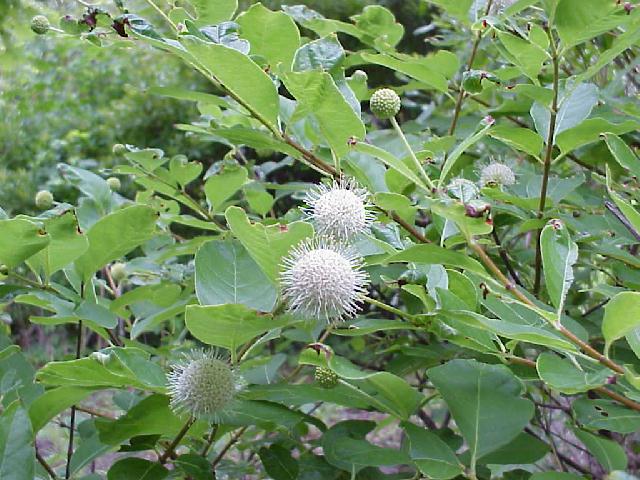
Weird-looking but spectacular are the blooms on Cephalanthus occidentalis, usually referred to as the Buttonbush. The blooms are perfectly round balls or spheres!


Buttonbush is native to the Eastern United States and as far west as Texas. Although you might have never seen one, when found growing naturally, it is usually on the bank of a pond or stream. Close friends of mine have a pond in West Point, Georgia, that is almost completely surrounded with large Buttonbush plants. Such a beautiful sight it is, when in bloom with all the pollinators buzzing around it.

This native shrub absolutely loves water and likes having wet feet all the time, but it can be grown in ordinary garden soil too. Buttonbush is very easy to grow and tolerates almost any soil. Heavy clay is not a problem at all.

The flowers are fragrant, and like many blooms favored by pollinators, smell like honey.

Leaves are dark green and shiny. I have not noticed any pest or disease problems with the buttonbush. This shrub leafs out late, sometimes not until May here in Georgia. The leafs turn a soft yellow in fall before dropping.

Cephalanthus occidentalis will reach heights up to 7 feet or more, and will do so quickly in wet soil.

Plant Buttonbush in full sun or partial shade on a pond or stream bank if you are lucky enough to have one on your property. If not, plant it where you can reach it with a hose on a regular basis. Mine are planted by the greenhouse where I can water it whenever I think it needs it.

Buttonbush will grow in any soil. Regular garden soil is fine. Whatever you have--Heavy to average soil. Clay soil is fine. But amend it with some composted manure or compost to add fertility. 

Cephalanthus occidentalis loves water. Keep soil moist to wet. This shrub even tolerates standing water. Don’t allow to dry out. 

Bumblebees love Blooms on the Buttonbush
The Buttonbush can be grown almost anywhere in the United States, since it is hardy in USDA Zones 4 – 10.

If you want a whole row of them or plan to plant in mass, space them about 5 feet apart.

Buttonbush benefits from being cut back severely every few years to rejuvenate the plant.


Plant a buttonbush in your garden and the bumblebees and butterflies will certainly thank you! I have seen 2 or 3 bumblebees on one flower all at the same time.

June Blooms in my Georgia Garden: Climbing Hydrangea

Every time I walk behind the greenhouse this time of year, I notice the distinct fragrance of honey. I wish you could smell it. This honey scent comes from the blooms of the large Decumaria barbara plant completely covering the pine tree it climbs. This fragrant Wild Hydrangea Vine can grow up to 30 feet!

Decumaria barbara is usually referred to as Climbing Hydrangea because its delicate, lacy blooms do look like a white hydrangea bloom cluster, and it is in the hydrangea family. This plant is also known as Wood Vamp, but I have been unable to figure out why. If you know, I would welcome your comments. 

Decumaria is a native vine found growing mostly in the Southeastern United States and can often be found on a hike through the woodland in Georgia. It can be grown anywhere in the South, since it is hardy in USDA Zones 7-11.

Do not confuse this plant with the non-native Hydrangea anomala petiolaris, which is also known as Climbing Hydrangea.

Wild Hydrangea Vine is easy to grow and can be grown as a groundcover or allowed to climb any structure. Like some other flowering vines, this Hydrangea Vine will not bloom unless it is permitted to climb. Its aerial roots will attach itself to anything from a tree trunk to a brick or rock wall, but will not damage the tree or wall in any way.

Decumaria barbara prefers part shade and is one of the few native vines that will bloom in full shade. The fact that it is usually found growing along stream banks indicates that it enjoys moist soil.

The rich green leaves look beautiful all summer and are not bothered by any pests or diseases. I would suggest it to be grown on an arbor or trellis near the patio, but it is deciduous in our climate, so there would be no foliage in winter.

Climbing Hydrangea belongs in the wildlife garden. Birds and small mammals love to hide and build nests in the lush foliage. Butterflies and other pollinators love the flowers.

June Blooms in my Georgia Garden: American Elderberry

Large flat white flower clusters adorn each stem of the American Elderberry Bush at the edge of our garden today. Sambucus canadensis, known as the American Elderberry is a shrubby plant native to the Southeastern United States. This time of year you can spot the large bloom clusters on plants in ditches and moist spots along the roadside all over Alabama and Georgia. Perhaps you've noticed these large flowers on your commute to work or school and wondered what they are. 

The flower clusters provide nectar for all types of pollinators. When you examine the flowers up close, you find that they emit a nice honey scent into the air. Can pollinators smell that? If they cannot, I wonder how they find flowers that have the sweet nectar they want. 

The flower clusters are followed by small purple-black berries in late summer. The berries are adored by birds and make great wine. They do not taste good to me, but once my little boy ate so many that he vomited. The berries should be cooked before ingested. Little boys will eat anything and must be watched constantly, especially in the garden. I am fortunate that vomiting is the only thing he suffered that day. He is now 14 and since then has eaten very many things that horrify me, but that's a story for another day.


Elderberry loves water but is easy to grow in any garden. Sambucus spreads by suckers and reaches a height of 8-10 feet by the end of summer even if cut to the ground in early spring. Plant it at the back of the border or along the edge of your property, so the size will not be a problem. Looks particularly beautiful on the bank of a pond or stream, if you have one.

Sambucus canadensis can be grown just about anywhere in the United States, since it is hardy in USDA Zones 3-9.

Elderberry is not picky about its site, as it will grow great in either part shade or full soil, as long as soil is rich and water is plentiful. Well that's what it prefers, but I've found it will grow in regular soil where water is not plentiful, but just won't get as large, and will be quite leggy.

Whether you use the flowers and berries yourself or not, consider planting Elderberry in your garden. It is a great plant for wildlife.

May Blooms in my Georgia Garden: Caldwell Pink Rose

One of the showiest roses in my garden today is the Caldwell Pink Climbing Rose. Considered to be one of the "found" roses, Caldwell Pink is a polyantha that might be the same rose as Pink Pet from China. Caldwell Pink Climbing Rose blooms here in May each year, and when it does, it'll knock your socks off. The plant is absolutely covered with large clusters of small 2-inch fluffy pink blossoms. It is a rampant grower that will quickly cover a fence or arbor, rooting wherever it touches the ground. Although the blooms have very little fragrance if any, this is one of my favorites. Unfortunately, we won't see the blooms again until next year, since Caldwell Pink Climbing Rose is not a repeat bloomer.

Not so with the Caldwell Pink Shrub Rose. The shrub form of Caldwell Pink blooms continuously until the first Fall frost. Unlike the climber, Caldwell Pink Shrub Rose is a compact bush about 4 feet tall, so it is perfect for the small garden or in a foundation planting.

Whether you choose the climber or the shrub, Caldwell Pink Rose is very easy to grow. It tolerates the heat and drought common in our Georgia garden during the summer, Caldwell Pink can be grown in colder climates too, hardy in USDA Zones 6 through 10. The foliage remains clean and vibrant green throughout the season, never requiring spray chemicals of any kind. 

June Blooms in my Georgia Garden: Oakleaf Hydrangea

This time of year our garden is always bursting with blooms, but this year has been a little different. Due to a very mild winter, everythin...