Georgia Drought is Here Again!
After a spring with plenty of rainfall, summer has definitely been summer here in Georgia! One of the Red Buckeye Trees in our garden has lost every single leaf! It is still living however. Many of our native plants are accustomed to this annual drought to which the southeast is prone. Leaf loss can be simply a survival tactic--plants will defoliate and sort of hibernate when conditions become too difficult and will spring back to life when moisture levels and temperatures are more to their liking. Some plants will actually put on a whole new crop of leaves in September. If plants in your garden appear to be dead, you can check for signs of life by simply scratching the bark with your fingernail. If you see green, your plant is still alive!

Clethra Attracts Hummingbirds and Butterflies to the Garden in Summer

Blooming in the middle of the hot summer is enough reason to name it Summer Sweet, but I think that common name derives from either the sweet fragrance or the sweetness of the nectar. Butterflies, hummingbirds, and other pollinators love it as much as you will, and they'll appreciate you for planting it in your garden.
Once the blooms fade, dark black seeds are visible on the tips of the stems, hence the other common name Sweet Pepper Bush.
There's a Clethra suitable for just about every garden, since a variety of types are available.
- Ruby Spice has rosey pink blooms on a large growing shrub up to 10 feet tall.
- Hummingbird has white blooms on a more compact plant around 3 feet tall. This is the one seen growing around Hummingbird Lake at Callaway Gardens.
- Sixteen Candles 6 inch long white flowers on a tidy shrub about 4 feet tall.
All Clethra varieties are very fragrant, reminding me of fresh honey.
Clethra is easy to grow, but does need regular water. Perfect around a pond or stream, but you can grow it right in your garden as long as you can water it weekly.
Clethra grows well anywhere in USDA Zones 4-9.
An added bonus is that Clethra displays lovely yellow foliage in fall!
For Clethra plants by mail, go to Shady Gardens Nursery.
Humane No Kill Mousetrap: Mice Cube Safe around Children and Pets
Our concern for animal welfare is apparent upon visiting our garden. Most of our pets were just dropped off here and we let them stay. Even critters often thought of as a nuisance are welcomed here to a degree. My husband, normally thought of as a tough guy policeman type, has been teased for being too tenderhearted toward mice and spiders, and has many times caught them indoors, carried them out to the briars, and let them go safely on their way.

Several months ago, mice became a problem in the greenhouse. Small little field mice can do much damage quickly, munching on simply everything! One would think mice would not be a problem here with 3 cats! But then it's hard for them to catch mice during their sleep.
That's when I discovered the Mice Cube. I couldn't believe how well it worked! And it's chemical free! The Mice Cube is a small clear plastic rectangular container with a trap door on one end. The mouse can enter to eat the bait, but cannot exit, since the door opens inward only. Our bait is a cheezit with peanut butter spread on one side. Within just a few hours we had caught a little guy who we safely deposited at the fence. The next morning we found 2 little mice inside.
The only problem we've seen with the Mice Cube is the cats--If one of them gets to it before we do, they let the mouse out, and then we have to catch it again!
Several months ago, mice became a problem in the greenhouse. Small little field mice can do much damage quickly, munching on simply everything! One would think mice would not be a problem here with 3 cats! But then it's hard for them to catch mice during their sleep.
That's when I discovered the Mice Cube. I couldn't believe how well it worked! And it's chemical free! The Mice Cube is a small clear plastic rectangular container with a trap door on one end. The mouse can enter to eat the bait, but cannot exit, since the door opens inward only. Our bait is a cheezit with peanut butter spread on one side. Within just a few hours we had caught a little guy who we safely deposited at the fence. The next morning we found 2 little mice inside.
The only problem we've seen with the Mice Cube is the cats--If one of them gets to it before we do, they let the mouse out, and then we have to catch it again!
To find out how you can purchase Mice Cube, click here.
Hibiscus: Choose Native for an Easy, Beautiful, Low Maintenance Garden
Every summer many, many people purchase the Tropical Hibiscus to place on their patio, porch, or around their pool. While it is true that the Tropical Hibiscus is beautiful and really does lend a tropical look to the garden, it will die to the ground with the first frost unless you live in the sub-tropical states. And if you've ever tried overwintering one indoors, you know how difficult that can be!
Instead, consider our American Native Hibiscus varieties. There are several, and in my opinion they are much more beautiful than the Tropical Hibiscus. Our native hibiscus is an herbaceous perennial plant that grows to shrub size each summer.
Hibiscus coccineus has bright red star-shaped blooms all summer on tall stems. This native hibiscus is known by many common names, among which are Texas Star Hibiscus, Swamp Hibiscus, and Swamp Mallow. The Swamp Hibiscus loves consistently moist soil but grows well in my garden with only a weekly watering. Hibiscus coccineus is beautiful even when not in bloom, having reddish-tinged green leaves shaped like maple leaves. Some visitors have claimed it looks like marijuana, but I can't say for sure, since I've never seen a marijuana plant. Perhaps they're telling on themselves! What do you think?
 |
| Hibiscus coccineus at Shady Gardens Nursery |
'Very spectacular' is the best description for Hibiscus moscheutos or Swamp Mallow. Blooms are the size of a dinnerplate! See for yourself:
 | |
| Hibiscus moscheutos growing alongside Rudbeckia Goldsturm |
Hybridizers have developed many types and colors, but all are beautiful and any one would be a show piece in your garden.
The native hibiscus is so easy to grow that it would be a shame not to have one in your garden. Hibiscus coccineus is hardy as cold as USDA Zone 6 and Hibiscus moscheutos is happy in even colder temperatures found in USDA Zone 4! Wow! They are deciduous plants but will return in May each year with no special care.
For more information on availability of the hardy native hibiscus, contact us anytime at Shady Gardens Nursery.
Alabama State Wildflower: Oakleaf Hydrangea
 |
| Hydrangea quercifolia, Oakleaf Hydrangea |
I am glad to learn that my favorite native shrub, the Oakleaf Hydrangea, is the State Wildflower of Alabama. Since I was raised in Alabama and we now live in Georgia very close to the Alabama state line, I am naturally drawn to plants native to Alabama.
The Oakleaf Hydrangea is very easy to grow, tolerating a wide variety of conditions. This deciduous shrub is native to the southeastern United States.
Hydrangea quercifolia gets its common name of Oakleaf Hydrangea from the large leaves shaped like those of our mighty oak tree. Deciduous foliage turns red in autumn and later falls from the plant but can hang on for quite a while when grown in shade during a mild winter. Once foliage falls from the plant, cinnamon colored exfoliating bark adds to its beauty.
Large blooms appearing in panicles in May and June last all season. Blooms begin white in color but change gradually to a rosey pink or purple and finally age to a soft brown persisting into the winter. Blooms are also quite long lasting as a cut flower.
The Oakleaf Hydrangea will grow large and can reach a size of about 8 feet tall and just as wide.
This deciduous shrub is not picky about soil, even tolerating heavy clay, but grows best in well-drained soil with moderate moisture. The Oakleaf Hydrangea is very drought tolerant once established and was the only hydrangea that bloomed in our garden during the severe drought of 2008 and 2009.
Hydrangea quercifolia can be found growing wild in all areas of Alabama, making it the ideal choice for the official wildflower of the state of Alabama.
State Wildflower of Georgia: Native Azalea
Since 1979, the native azalea has been the official state wildflower of Georgia. A certain variety was not chosen since several different species occur naturally in every county in Georgia.
Native azaleas are a member of the rhododendron family and are deciduous shrubs. Most varieties of these wild azaleas have highly fragrant blooms. Bloom color is spectacularly diverse and can be white, pink, yellow, orange, red, or any combination of those colors. With several species planted, you can have blooms in your garden from March all the way through August.
These wild azaleas naturally occur in the woods, but they will often flower much more profusely when planted in full sun. Some species cannot take direct sunlight, but most varieties can tolerate morning sun or filtered sun beneath tall deciduous hardwood trees. Beneath large oak trees is an ideal location for native azaleas, since the fallen oak leaves contribute to an acid soil favored by all azaleas.
Native rhododendrons will become more drought tolerant once established, but water regularly the first few years.
Well-drained soil is necessary for the survival of all azaleas, but Rhododendron viscosum, commonly referred to as the Swamp Azalea, can grow in wetter soil where it will receive ample water to grow large and full.
 |
| Rhododendron viscosum |
The early spring blooming native azaleas form their bloom buds in late summer, right when Georgia is usually experiencing a drought. To insure that you have fragrant blooms to enjoy in March and April, water your azaleas weekly during August and September unless it is raining regularly.
A very popular native azalea species is Rhododendron Austrinum, the Florida Flame Azalea. The Florida Azalea is prized for its colorful fragrant blooms appearing in early March. This is one of the easiest wild azaleas to grow, since it tolerates heat and drought once established.
 | |||
| Rhodendron austrinum |
If pink is your color, you have more than one choice. Most often seen in the woods of Georgia is the Piedmont Azalea, Rhododendron canescens. This wild azalea is also easy to grow and will eventually become a large specimen. Bloom color on this one can actually vary on individual plants though, and you might end up with flowers that are more white than pink.


That is also true of Rhododendron colemanii, the Red Hills Azalea. Native to the Red Hills of Alabama, this azalea can also be found growing wild near the Chattahoochee River in Georgia. Blooms on this one can be white, pink, yellow, or orange.

As you can see in the photo above, the Red Hills Azalea can have both yellow and pink on the same plant. If you prefer a pink bloomer on either the Piedmont or the Red Hills Azalea, choose your plants in spring when they are in bloom.
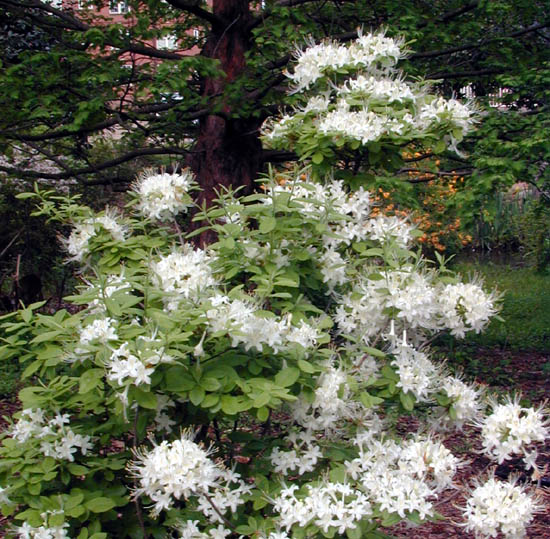
For a white garden, you have several choices. In addition to the Swamp Azalea, you might choose either the Sweet Azalea or the Alabama Azalea for fragrant white flowers. Rhododendron arborescens is often considered to have the loveliest flowers of all. Solid white blooms are deliciously fragrant, which is probably the reason for its common name of Sweet Azalea.
The Alabama Azalea, Rhododendron alabamense, can be found growing in Georgia as well. White blooms with a bright yellow blotch smell like lemons. This wild azalea is very drought tolerant once established, making itself at home on dry rocky slopes in Alabama and Georgia. Even if summer drought kills the topgrowth, this shrub will usually send up new stems from the roots the next spring.
 |
| Alabama Azalea |
One of the more difficult to grow native azaleas is also one of the most beautiful. Made famous by Callaway Gardens is the red blooming Plumleaf Azalea, Rhododendron Prunifolium. This plant occurs naturally only in a few counties in Georgia and Alabama in the Chattahoochee River Valley. Blooms are a vivid red or orange red. The Plumleaf Azalea needs a spot in the garden more shaded and cool. Rhododendron prunifolium wants no direct sunlight whatsoever. Don't forget to water this one during periods of drought or you'll lose it.
 | |
| Rhododendron Prunifolium, Plumleaf Azalea |
The most common problem with growing native azaleas is actually finding some available for sale in the first place. Most varieties of wild azaleas are either protected or endangered, so it is unlawful to dig them from the wild for transplanting in your garden. Online nurseries are a great source for native plants of all kinds, including native azaleas. A good selection of these fragrant native azaleas and many other native plants can be found at Shady Gardens Nursery.
Getting the Garden Ready for a Hot Georgia Summer
 |
| Gaillardia at Shady Gardens Nursery |
Getting the garden ready for a hot Georgia summer can be easier than you think!
Plant selection is most important—choose plants you know will thrive in your area. Planting trees, shrubs, and perennials native to your climate zone means less work for you, because native plants are accustomed to the difficult conditions our Georgia summers offer. They are better able to withstand our drought, and some native plants even prefer our muggy, humid temperatures!
Always amend the soil with compost or composted manure. Plants are better able to tolerate harsh conditions when they have good soil to live in.
Don’t overlook the importance of mulch. Apply a thick layer of organic mulch such as straw, bark chips, or shredded leaves to conserve moisture, keep the plant roots cool, and prevent weed growth. Gravel mulch is not suitable for our climate, except in a cactus garden, because it heats up too much in the summer.
Finally, if your budget allows, install a soaker hose or drip irrigation watering system. This will get the water down to the roots where it’s needed with less water waste.
Subscribe to:
Posts (Atom)
June Blooms in my Georgia Garden: Oakleaf Hydrangea
This time of year our garden is always bursting with blooms, but this year has been a little different. Due to a very mild winter, everythin...

-
 Lonicera sempervirens Red Trumpet Honeysuckle A spectacular vine blooming in our garden in April is the native American Honeysuckle ...
 -
 It's hard for me to believe people continue to spend money on those tropical hibiscus plants every year, when they could buy the har...
 -
 Known by many as the harbinger of Spring, Forsythia explodes with bright yellow blooms in very early Spring, or sometimes even in lat...