Showing posts with label tolerant. Show all posts

November Blooms in my Georgia Garden: Pink Muhly Grass

Pink Muhly Grass at Callaway Gardens
when my Children were small
The most beautiful of all the ornamental grasses to me is Muhlenbergia capillaris, usually called Pink (or Purple) Muhly Grass.

When not blooming, Pink Muhly Grass just disappears into the background. No one would notice it at all. But in late Summer or early Fall when the pink to purple seed heads develop, all I can think is WOW! 

Usually Pink Muhly Grass comes into bloom in September but is blooming much later this year, I'm guessing due to the drought. The plants are just now in full bloom. Everything has behaved differently this year. As I wrote in my last post, we've had no rain in our Georgia garden in more than two months. None. 

That just goes to show you what a tough plant this is. Most ornamental grasses are truly easy to grow, requiring nothing special in the way of soil or water. But most ornamental grasses just don't appeal to me. I love flowers.

Pink Muhly Grass gives me the look of flowers in the big beautiful fluffy clouds that look like cotton candy held high above the foliage. When in bloom, Pink Muhly Grass can be in excess of 3 feet tall. This plant is truly spectacular in the Fall garden.  And by the way, Muhlenbergia capillaris comes in White too. What I mean is there is white blooming form, but to me it is not so eye-catching.

Muhlenbergia is a clumping grass so it will not spread all over your garden. It is a very well-behaved plant native to the Eastern United States, and is hardy in USDA Zones 5-10. 

Muhly Grass also attracts beneficial insects. I'm not sure why, but ladybugs like it. 

Muhlenbergia capillaris needs very well-drained soil, so I recommend mixing in some compost when you plant it. And although it is drought tolerant once established, water it weekly during its first Summer in your garden.
 
Pink Muhly Grass is spectacular enough to be a specimen plant, but I like the drama of a large mass of them, if you have the space. It is particularly lovely if you can plant at the top of a hill where it will be backlit by the sun.

November Blooms in my Georgia Garden: Osmanthus fragrans, Sweet Tea Olive

Osmanthus fragrans
I've been anxiously awaiting the blooms on my Tea Olives ever since Fall arrived. We've been under a severe drought here in Georgia for a couple of months now. Most of our plants are suffering, and many have refused to bloom. Some established shrubs and trees might even die. 

But there she is, my Tea Olive, blooming anyway. I admit, the blooms are not as plentiful as usual, but they are still there, and I can smell their sweet fragrance. 

Osmanthus fragrans is one of my favorite evergreen shrubs. When in full bloom, my whole garden smells like fresh apricots! 

Osmanthus fragrans 'Fudingzhu'
I must say Osmanthus fragrans is one of the easiest plants to grow. This evergreen shrub grows very large over time and does well in full sun to part shade. Not picky about soil, the tea olive tolerates clay soil and is drought tolerant (once established.) 

The most sensational bloom is in fall, but Osmanthus fragrans blooms sporadically year round. The fragrance is most notable in the evening on warmer days. Blooms are so tiny that you'd never suspect the heavenly fragrance is coming from them!

An exception to that is Osmanthus fragrans 'Fudingzhu', which has showy clusters of the tiny blooms--still with that same sweet fragrance.

Osmanthus fragrans 'Aurantiacus'
Orange Blossom Tea Olive
Evergreen foliage is a rich green that holds up well in floral arrangements. 

Osmanthus fragrance is hardy in USDA Zones 8-11, but is often seen in Atlanta which is Zone 7. Can withstand temperatures down to 10 degrees with no foliar damage.

Although we have some blooms on the Osmanthus shrubs that have been in the garden several years, I fear the we'll see no blooms this year on our Orange Blossom Tea Olive, Osmanthus fragrans 'Aurantiacus.'

November Blooms in my Georgia Garden: Sasanqua Camellia

Right in the middle of the Fall harvest season not much thought is given to flowers. This is the time when our homes and front porches are decorated with hay bales, pumpkins, and scarecrows.  Fall or Autumn is my favorite season for many reasons, and I love decorating with the usual harvest items like pumpkins and gourds. But I still want to see flowers in my garden.

Sasanqua Camellias give me just that. Available in many bloom colors, Sasanquas bloom reliably in the Fall every year. 

I’ll never forget the first time I saw a Camellia in bloom. I was young, and I was new at gardening. I was driving through a residential area when I noticed a large, bushy, green shrub with large red blooms that looked like roses. Believe it or not, it took me a while to find out what it was! You’re probably laughing at me now, but thank goodness I’ve learned a few things about camellias since then. 

It wasn’t until attending the Master Gardener Course that I learned of the Sasanqua Camellia. Sasanquas are early bloomers, usually blooming October – December, so there is less chance of frost damaging the blooms. The fall blooming Sasanquas make great holiday decorations and gifts. Sasanqua camellias seem to be faster growing and are often larger growing than Japonica. Dwarf Sasanquas are available too--great for small gardens or even containers. Some varieties bloom so profusely that the blooms hide the foliage! 

Sasanqua Camellias prefer a sheltered site away from drying winter winds. The blooms are more delicate than those of Japonica Camellias. Bright, filtered shade beneath tall trees is ideal. Moist, well-drained soil is best, but camellias are drought tolerant once established. 

Although our garden has received no rain in over 8 weeks and Troup County is under a severe drought , the Sasanquas are beginning to bloom anyway. 

Remember that deer will eat the blooms on all camellias, so consider using a deer deterrent around them. Your local Humane Society or Animal Shelter has plenty of inexpensive deer-deterrent—the all-natural kind. Just ask the attendant which dogs are frisky enough for deer control! 

October Blooms in my Georgia Garden: Spider Lily, Lycoris radiata

Lycoris radiata is most often referred to by one of its common names. We always called them Spider Lilies, but in other parts of the South, it is known as Hurricane Lily, since it blooms at the height of Hurricane Season. Each summer we are plagued here in Georgia with a drought that goes on for weeks (if not months), and in September we'll finally get a drenching rain. It is after that good soaking rain that Spider Lilies pop up in old gardens of the South. This year, we did not receive that soaking rain at all, so the Spider Lilies finally bloomed without it--in October.


Lycoris radiata blooms have extremely long anthers that give them a "spider-like" appearance, hence the common name Spider Lily. Once the flowers fade, dark green basal leaves appear that look much like liriope (or "monkey grass", as it usually called around here.) Its leaves will stay green all winter here in Georgia, absorbing nutrients from the sun to convert into energy for the next summer's blooms.

Lycoris radiata is hardy only in the Deep South, in USDA Zones 7-10, but it is still easy to grow. Like other members of the Lycoris family, it tolerates any soil in either sun or shade and needs no supplemental water to thrive. 


I have only the red blooming Spider Lily, but it also can be found in white. I'm still looking for some.


All species of Lycoris should be divided or transplanted only when dormant, so as not to interrupt its bloom and growth. Early summer is the optimum time for this task. Once the foliage has withered, it is safe to dig the bulbs.

Lycoris does extremely well beneath large established trees.

The flowers make excellent cut flowers and hold up well in a vase, lasting for several days in a floral arrangement. 

And one more thing: Deer won't eat your Spider Lilies!

October Blooms in my Georgia Garden: Asters

Aster 'Raydon's Favorite' in October
If you see me when I come home from pretty much anywhere this time of year, you'll find me unloading at least one mum. I bring one home almost every time I go to the store. But where do they end up? Well, I do plant them of course. But they just don't last very long in my garden here in Georgia. Our summers are very hot and dry. This year, the drought has extended into Fall. This is the driest Fall I can remember. We haven't had any rain at all in over 2 months.


Unlike Chrysanthemums, Asters, will live on for years, in spite of the drought we usually suffer here in Georgia. There are many Fall blooming Aster varieties to choose from, and I intend to add them all to my garden! There are asters for full sun and asters that will bloom well in shade.

Symphyotricum oblongifolium 'Raydon's Favorite' is covered with lavender daisy-like blooms every Fall in September and October. The aromatic foliage reminds me of mint and deer do not like it.

Butterflies and other pollinators love all varieties of aster. In mid-Fall, most other flowers have finished blooming, but the Fall asters are just getting started. Most aster plants are just covered in flowers this time of year. Asters make excellent cut flowers, lasting a long time in a Fall floral arrangement.

Our native asters are much easier to grow than chrysanthemums. Once established they are quite drought tolerant, thriving on sunny hillsides even in the midst of a drought. Asters tolerate just about any soil--dry, clay, or sandy.

This native plant can be grown anywhere in the United States, since it is hardy in USDA Zones 3-8. Most asters like full sun, but there are asters that bloom even in shade.

This year The Garden Club of America named Aster oblongifolius 'Raydon's Favorite' as the 2016 Plant of the year, so it definitely deserves to be in your garden.

The only negative I can think of with Raydon's Favorite is that it will grow quite tall and flop over if it isn't pruned early in the summer. I am bad about forgetting to prune.

March Blooms in my Georgia Garden: Lady Banks Rose

One of the easiest roses of all to grow is the Lady Banks Rose. Rosa banksiae is a thornless rose producing soft fluffy blooms in early Spring. Lady Banks Rose is almost evergreen here in Georgia, if temperatures don't drop below the 20's. 

Lady Banks Rose is drought tolerant and disease resistant by nature. This lovely rose tolerates poor soil too.

Lady Band Rose is an easy care rose that is thornless and almost evergreen here in Georgia. It is a climbing rose that is beautiful growing on a pillar, arbor, fence, or trellis. 

Although Lady Banks blooms only once a year, in Spring it is absolutely covered with small fluffy double blooms.  Blooms are slightly fragrant and come in either yellow, Rosa banksiae 'Lutea', or white, 'Rosa banksiae 'Alba plena.' 

Rosa banksiae originated in China but was introduced to Europe in the early 1800's.  Lady Banks was very popular in the Southern United States during Antebellum times and was usually found on old plantations of the South. The largest rose in the world is a white blooming Lady Banks Rose that was planted in Tombstone, Arizona, in 1885. 

Plant your Lady Banks Rose in full sun for best bloom. This is a fast-growing strong rose that will quickly become very heavy, so plant it near a very strong support. Those inexpensive little trellises at the discount store will not work.

Lady Banks Rose is evergreen in USDA Zones 8-10, but is hardy in colder zones 6-7 where it will lose its leaves in winter. Banks Rose is said to withstand temperatures down into the teens, but we have single digit temperatures every so many years and our established plants lived through that. 
Once established, Lady Banks Rose is quite drought tolerant, but be sure to water regularly the first few years. Lady Banks is somewhat hard to find in nurseries, so you don't want to have to try to replace it.

Lady Banks, unlike many other roses, can be grown near the beach since it tolerates salt spray.

Lady Banks is not bothered by diseases and pests that infect most roses, so you won't need to spray at all.

If you don't have an arbor or trellis, Lady Banks can be grown as a free-standing shrub rose, but must be drastically pruned yearly to keep it in check. If pruning is needed, do so immediately after flowering. 

March Blooms in my Georgia Garden: White Chinese Fringe Bush

I wish you could smell the fragrance coming from our White Fringe Bush, Loropetalum chinense, also known as Chinese Fringe Flower. As you can tell by the bloom, it is in the Witchhazel family.

Pink-flowered Loropetalum has been widely planted around the Southeastern United States in the last several years, used in almost every commercial landscape in Georgia. And for good reason! The many different cultivars are beautiful in every season of the year. But here in my Georgia garden, I also love the white blooming form. Although it doesn't bloom as many times per year as the purple-leafed variety having pink blooms, when in bloom, the White Fringe Bush is absolutely covered with fragrant spidery flowers! (I can't believe I called something "spidery" in a complimentary way, but only when I'm speaking of a flower.)

Although Loropetalum thrives in full sun, my White Loropetalum is planted in almost full shade, and it still blooms in a spectacular fashion.

Although I've read that the white-flowering form of Loropetalum was introduced to the United States during the 1800's, it didn't become popular until after the purple leafed varieties were introduced in the 1980's. 

White blooming Loropetalum is just as easy to grow as its purple leafed (and pink blooming) relative. Full sun to light shade will promote plentiful blooms. 

Mature size is large, 10 or more feet tall and just as wide.  Loropetalum can be allowed to grow as a huge shrub, or it can be limbed up into a tree form, depending on your space.

I have not seen this shrub wilt even in the severest drought or the hottest summer.

Loropetalums grow very well in the Southern parts of the United States, as they are hardy in USDA Zones 7-10.

I do not know the cultivar of my White Fringe Bush, since information I find online describes heights of 4 feet and ours is in excess of 6 feet tall.  That doesn't matter to me. All I need to know is what I see when I look at it in bloom in March every single year. 

March Blooms in my Georgia Garden: Forsythia

Known by many as  the harbinger of Spring, Forsythia explodes with bright yellow blooms in very early Spring, or sometimes even in late Winter here in Georgia. Forsythia blooms reliably every single winter, no matter what the weather conditions have been. I have seen the blooms of Forsythia open as early as January or February, or not until March, depending on what kind of Winter we are having.

Forsythia is a deciduous shrub that blooms in late winter or very early Spring with bright yellow blooms that open before leaves appear. The common name, Yellow Bells, seems fitting, because the blooms do look like yellow bells dangling along the stems. 

Although Forsythia is widely grown in gardens all over the Unites States, it is native to China. 

Forsythia blooms well even in shade
Bloom seems to be most prolific when grown in full sun, but we have a few plants growing in the woods where the bright golden yellow blooms are visible from a distance and draw attention to the woodland garden.

Forsythia does not self-sow and become invasive in the landscape, but stem cuttings root easily if you want to make more plants for your garden.

Forsythia grows very large over time (8-10 feet tall and up to 12 feet wide), so
give it plenty of room. The cascading branches are lovely when allowed to grow naturally with no pruning. Stems will root themselves when allowed to touch the ground, and this is an easy way to get more Forsythia plants. Pruning isn't necessary or desired, except to remove old woody growth or dead wood. When pruning, remove old branches to the ground, making room for the growth of new stems. This should be done in Spring, immediately after flowering, since Forsythia will bloom next Spring on the stems from the previous year.

Forsythia, also known as Golden Bells, can be grown in most of the United States, since it is hardy in USDA Zones 5-10.

Forsythia is a fast grower, so you can start with a very small plant. The Forsythia shrubs in our garden have proven to be very drought tolerant and are growing in poor soil that was not amended at planting. 

Forsythia is a great shrub for forcing bloom indoors before it would bloom outdoors. I like to cut long stems in early January and place them in a large vase of warm water. I can watch the buds develop into blooms that will open indoors much earlier than they would outside, reminding me that Spring is coming!

Loropetalum Zhuzhou 
Purple Loropetalum is a beautiful companion for Forsythia. Not only do they bloom at the same time, but even the foliage will provide nice contrast in the garden--Loropetalum with its purple foliage is striking against the bright green leaves of the Forsythia. You'll have to imagine this vision, since I failed to get a photograph of the two together when in bloom. 


March Blooms in my Georgia Garden: Bridal Wreath Spiraea


One of the earliest shrubs to bloom in our Georgia garden is Bridal Wreath Spiraea. The variety we grow is S. cantoniensis ‘Lanceolata’, which is absolutely covered with double blooms that look like tiny white roses. The blooms appear all along the stem, also resembling stems of Baby's Breath, which is common of floral arrangements. I have used Bridal Wreath stems similarly in my floral arrangements when the shrub is in bloom. 

Bridal Wreath Spiraea is very easy to grow. For the showiest bloom, plant in full sun where the large-growing shrub has plenty of room to grow. The arching stems will ultimately reach up to 6 feet tall and just as wide.

This spiraea can be grown in most parts of the United States, as it is hardy in USDA Zones 5-9b. 

Spiraeas are known to be very drought tolerant, and the one in our roadside garden gets no supplemental water at all. The soil in that bed is very hard clay.

February Blooms in my Georgia Garden: Fujino Pink Spirea

One of the earliest shrubs to bloom in our Georgia garden is the lovely Spiraea thunbergii 'Fujino Pink.'

Fujino Pink Spiraea in February
Fujino Pink Spiraea is a beautiful, fine branched spirea that sports masses of pink buds along the stems which open to light pink flowers in late winter to early spring before the leaves emerge. This shrub is a soft, airy plant that looks great massed or as a hedge.

Some spiraeas (also often spelled 'spirea') grow very large, but this is one of the small ones maturing to about 4 feet high and wide, making it perfect for a small garden.

Spiraea thunbergii can be grown all over the United States, as it is hardy in USDA Zones 4 - 9.

For best flowering, grow spiraea in full sun, but we have quite a few that receive only part sun and bloom just beautifully anyway. That's typical for our garden, since summer sun can be too intense for delicate foliage.

Spiraes prefer well-drained soil with regular water, but Fujino Pink Spiraea is drought tolerant once established. As I've said before, no shrub is considered established until it has been planted at least a couple of years.


July Blooms in my Georgia Garden: Surprise Lily, Lycoris Squamigera

A late-blooming flower you'll probably see only in the South is the old-fashioned favorite, Lycoris.

Lycoris squamigera in July
Lycoris squamigera, is usually referred to as Surprise Lily, but a funny common name for this plant is Naked Ladies. Surprise Lilies blossom in the middle of summer, usually sometime after the 4th of July. The bulb lies dormant a good portion of the year, and then suddenly surprises us by sending up a naked flower stalk up to 2 feet tall, topped with very fragrant pink trumpet-like flowers that look somewhat like a cluster of amaryllis. It is in the amaryllis family. Leaves do not emerge until the flower stalk has faded. The trait of having a flower stalk with no foliage at the bottom is the reason for the amusing common name "Naked Ladies." Leaves are strappy medium green leaves like you'd expect from a lily, but by early Fall they turn yellow and disappear again.


Probably because it grows from a bulb, Lycoris squamigera is very easy to grow. Growing equally well in sun or shade, Lycoris is very versatile and is at home in any southern garden. However, you can grow this one even if you live in a colder climate, since it is hardy in USDA Zones 5-9. Squamigera is the most cold hardy of all Lycoris.


Surprise Lily is not picky about soil. Whether you have clay or sand or even the very rare "good soil," Lyoris squamigera will thrive and multiply. It doesn't even matter if your soil is acid or alkaline.


Lycoris squamigera will appreciate regular water during the growing season, but it's just not necessary. And once it goes dormant and the foliage has disappeared, it needs no water at all.

June Blooms in my Georgia Garden: Hypericum, St. Johns Wort

Some of the most unusual blooms in my garden are found on the Golden St. Johns Wort, Hypericum frondosum. Clusters of bright yellow blooms cover the shrub in June. The blooms are difficult to describe, but I'll try. The flower looks like a yellow fluffy ball of stamens backed by flat yellow petals that curve backward a little bit. Just take a look at the photo. When in bloom, nearly every flower has a bee on it, just about all the time.

A small shrub, Hypericum frondosum, has blue-green leaves that are long and narrow. It is deciduous in our climate. Hypericum makes an excellent speciment plant but is eye-catching when massed in a large garden. 

The variety we grow is 'Sunburst', and it is slightly variegated with a creamy yellow edge to most of the leaves. Excellent color in the Fall when leaves turn a reddish orange. Sunburst grows to about 5 feet tall with a mounding habit. It is a great choice for Georgia and other Southeastern states. 

Blooming a little later is the Bushy St. John's Wort, Hypericum densiflorum. The word densiflorum indicates dense flowers. Hypericum densiflorum is native to the coastal areas of the Eastern United States.

Elongated leaves are bright yellow-green.


Blooms are slightly smaller than those on frondosum, but the bright sunny yellow flowers absolutely cover the shrub and are loved by pollinators of all kinds. If you look closely at the photo, you can see blooms in all stages of development, showing that Shrubby St. John's Wort blooms for a very long time.
This hypericum is even more versatile than frondosum and can be grown in moist areas along stream banks as well as on dry hillsides. 

Hypericum densiflorum is threatened in some states and endangered in others, so do not dig it from the wild. Although Shrubby St. John's Wort is bushy and compact, it is not a dwarf and will reach up to 6 feet tall at maturity. 
St. John's Wort is easy to grow. All Hypericums can be grown in full sun or shade. Most of mine are in deep shade and they still bloom prolificly. This is a shrub that actually thrives in poor, sandy, acid soil--as long as drainage is good.

Of course, regular water is best, but Hypericum is very drought tolerant once established.Hypericum blooms on new wood, so it can be cut to the ground in late winter and it will still bloom in summer. Growth rate is moderately fast. If pruning becomes necessary, wear gloves, since hypericum has a sap that can irritate sensitive skin and may cause an allergic reaction.

If you'd like to grow them massed or as a hedge, space them 3 or 4 feet apart.Drought tolerant, so great for xeriscaping and a good choice for a roadside planting.

The blooms attract butterflies and other pollinators to the garden.

St. John's Wort can be grown in virtually any American garden, since it is hardy in USDA Zones 5-9. 

June Blooms in my Georgia Garden: Hydrangea arborescens

Voluptuous is the word that comes to mind every time I look at my Annabelle Hydrangeas. Huge bloom clusters can be 10 - 12 inches across and are so heavy that they weigh down the branches. The flower clusters are a pure white, and they hold up well in a vase where they can be enjoyed indoors. Annabelle is a selection of Hydrangea arborescens, native to the Eastern United States.

This smooth hydrangea, Hydrangea arborescens, is much easier to grow here in the South than the common mophead Hydrangea from Asia. Smooth Hydrangea is considerably drought tolerant. It loves the shade and grows quite happily in the dry shade of my woodland garden. Annabelle is also very cold-tolerant. Even if you live where it is too cold to grow macrophylla hydrangea, you can grow Annabelle. Hydrangea arborescens 'Annabelle' is hardy in USDA Zones 3-10.

Unlike the common mophead hydrangea, Annabelle will bloom every year, even if pruned in Winter or if we have a late frost. You see, Annabelle blooms on new growth, whereas macrophyllas bloom on last season's growth.  Also, since Annabelle Hydrangea blooms on new growth, unlike most other hydrangeas, this one will rebloom again in late summer if spent blooms are removed.

I enjoy cutting Annabelle blooms to take inside. The large flower clusters hold up well in a vase.

May Blooms in My Georgia Garden: Oakleaf Hydrangea

Hydrangea quercifolia

I've always said that my favorite hydrangea is our native Oakleaf Hydrangea, Hydrangea quercifolia. Honestly, this shrub is beautiful in every season! In Spring, new leaves emerge that are thick, rich green, and shaped like an oak leaf. Soon thereafter, bloom buds begin to develop, and you can tell early on which stems will have a bloom. Bloom size varies from plant to plant, but each bloom is a panicle shaped cluster of smaller flowers, all creamy white. With the species, this panicle can be smallish when compared to some of the named cultivars, but it is very beautiful. Pollinators just love it.


Hydrangea quercifolia 'Snowflake'


There are a number of named selections, of which I have only a few. The hardest one for me to find was Hydrangea quercifolia 'Snowflake.' Large panicles of blossoms have one flower on top of another, giving it the appearance of double blooms. This plant took a little longer to establish and bloom for me, because it receives no supplemental water other than the little bit of rain we get. This year we were blessed with plenty of rain, so my Snowflake Hydrangea is sporting beautiful fluffy blossom clusters like the one in the photo.


Hydrangea quercifolia 'Alice'


The most spectacular of these Oakleaf Hydrangeas has to be the cultivar known as 'Alice.' Blooms on the Alice Oakleaf Hydrangea are gigantic. These voluptuous blooms spikes can be 12 inches long or more. I'd have to say this one is my most favorite of all. If I had to come up with a disadvantage of this hydrangea, it would be that the blooms are so heavy that they weigh down the branch. Some of the branches with the largest blooms are laying along the ground due to the weight of the flower spikes. I should prop them up with something.


As they dry, the creamy white blooms age to a rosy shade of pink, unless your summer heat and lack of rainfall cause them to turn a crispy brown instead. Fall foliage is spectacular on all the Oakleaf Hydrangeas. With onset of cold weather, the large leaves change to a deep burgundy color, quite visible from a distance. And in winter, after the leaves fall, you'll notice the exfoliating cinnamon colored bark.

Oakleaf Hydrangea Blooms Age to a Rose Pink
Oakleaf Hydrangea is my favorite hydrangea, not only for its beauty but perhaps more importantly for its ease of growing. Mophead Hydrangeas are quite fussy. "Oh, it's too hot!", "Oh, I'm so thirsty!", "Oh, my soil is not right!" they seem to be saying to me whenever I glance in their direction. And if I don't give in to their demands, they will punish me, by first wilting, then drying up. Or they won't bloom. And sometimes they even just up and die on me.

Not so, with the Oakleaf Hydrangea. They don't mind our dry clay soil. They don't complain when it doesn't rain. Once established, Oakleaf Hydrangeas are very drought tolerant. And although they naturally occur in the woods, Oakleaf Hydrangeas will grow quite happily in full sun. My Alice gets the worst--full sun in the afternoon during the hottest part of the day. Yes, the Oakleaf Hydrangea is truly beautiful in every season. My gardens are mostly shady, so I have all kinds of hydrangeas, but my most favorite of all is definitely the Oakleaf Hydrangea.

Eucalyptus Silver Dollar Tree in the Garden

Most of you know that Eucalyptus cinerea, also known as the Silver Dollar Gum Tree or Argyle Apple, is commonly used in floral arrangements. But you might not realize how easy it is to grow your own.


Eucalyptus has very fragrant but also beautiful blue-green foliage with a silvery cast. During cold weather, leaves often turn a rosey burgundy. Eucalyptus makes a great specimen plant, but also looks great massed in groups of 3 or more. Bark is cinnamon-colored and exfoliating, adding to the beauty of the tree.

Warm summer breezes send the fragrance of eucalyptus all over the garden.

Eucalyptus cinerea is an evergreen tree that will grow up to 60 feet tall fairly quickly. 

Eucalyptus cinerea
 Shady Gardens Nursery
This variety of Eucalyptus is hardy in USDA Zones 7 to 11, tolerating light frosts with no leaf damage. When temperatures dipped down into the teens here, our trees showed some damage but quickly rebounded. This species has been known to survive winter in Zone 6, where it will die to the ground and resprout if dead foliage is pruned away. Can also be grown indoors in a large container. Just prune it regularly to keep it the size you want.

Eucalyptus cinerea grows rapidly in an irregular form. Give it plenty of space, because the branching can grow quite wide horizontally--this tree can be up to 15 feet wide. A height of 50 or 60 feet can be expected.

Eucalyptus needs full sun and well-drained soil. Hot dry sun is not only preferred but enjoyed. 

When you plant, amend the soil with soil conditioner and sand to insure the soil is very well drained. Then water once, at planting time. Do not overwater. That's all there is to growing Eucalyptus in your very own garden.

Drought Damage in my Georgia Garden

I took a walk in the garden today to assess the damage the drought has caused thus far. Many of the plants believed to be drought-tolerant have actually suffered quite a bit. I did find a few surprises when I noticed plants that still look great in spite of absolutely no water, so I thought I’d share them with you. 


Lady Banks Rose has not wilted, although she's been in the ground only one year. I can’t reach her with the hose, so I was a little worried. 


Other shrubs and trees with no wilt are: American Beautyberry, Holly, Paw Paw, Spirea, Arizona Cypress, and Rosemary. 


Established camellias and viburnums look fine, while newly planted ones wilt again every few days and recover only after a deep soaking. 

Mahonia from Shady Gardens Nursery
Although it will plant itself in your garden wherever it likes, Leatherleaf Mahonia never wilts. It provides a rough texture in the garden with its tough evergreen spiny leaves and bright yellow winter bloom sprays followed by dark purple berries that are loved by songbirds. It requires shade. Although it does reseed freely, I do not consider it to be an invasive plant. 

Perennials that still look great are Hosta, Rohdea, sedums, and succulents. Hardy Ice Plant is great for dry sun—rewarding you with flowers that open in full sun even with no rainfall. 

If you decide to add any of these recommended plants to your garden during this drought, remember that no plant is completely drought tolerant the first year, so water weekly in the absence of rain. In other words, water weekly, because obviously, there is no rain!

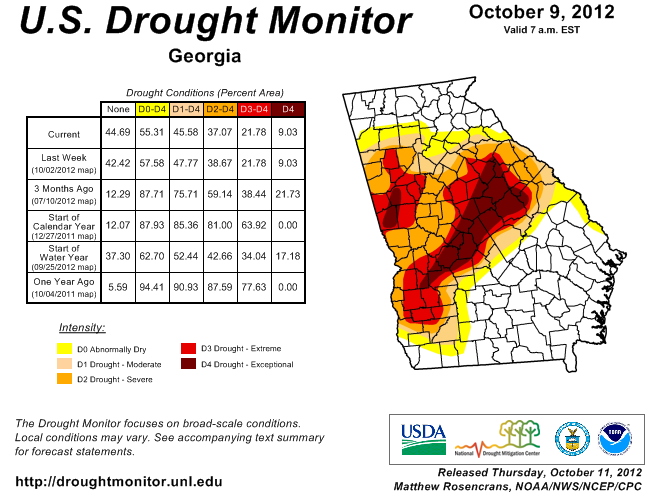
Georgia Drought Monitor

I don't yet know what I can do with this information, but my despair prompted me to get online to find out if the drought is as serious as I think it is. I found this site which confirms my suspicions:


Troup County is where we attempt to garden. And sure enough there we are, right there in a section labeled extreme/exceptional. And the "exceptional" section fills up most of Troup County, so I can be sure that includes us. Upon closer examination, I found that yes, of course, we are in that spot. I didn't really need to see this, because I know when I look at the ground outside that we are suffering.


What's Blooming Today at Shady Gardens Nursery? Camellias

Camellia Japonica (variety unknown-sorry, next time I'll use indelible ink)
I’ll never forget the first time I saw a Camellia in bloom. I was young, and I was new at gardening. I was driving through a residential area in the middle of January when I noticed a large, bushy, green shrub with large red blooms that looked like roses. Believe it or not, it took me a while to find out what it was! You’re probably laughing at me now, but thank goodness I’ve learned a few things about camellias since then. 

Large voluptuous blooms begin appearing in January on Japanese camellias here in our garden. The deep green glossy leaves provide a canvas for the blooms. Since camellias are evergreen, they provide the bones of the garden and also make a beautiful privacy screen if you need it.

A good companion for azaleas, camellias of all types should be planted in abundance in the Southern garden.

Camellias prefer a sheltered site away from drying winter winds. Bright, filtered shade beneath tall trees is ideal. Moist, well-drained soil is best, but camellias are drought tolerant once established. 

Remember that deer will eat the camellia blooms, so consider using a deer deterrent around them. Your local Humane Society or Animal Shelter has plenty of inexpensive deer-deterrent—the all-natural kind. Just ask the attendant which dogs are frisky enough for deer control! 

For additional deer control tips as well as a list of deer-resistant plants, consult Gardening in Deer Country. Please also notice the photos of our organic pest control staff to the right of this post.


What's Blooming Today at Shady Gardens?

Daphne Odora Aureomarginata Pink Shady Gardens Nursery
Daphne odora is in full bloom today at Shady Gardens Nursery. 

Blooming in the middle of winter is just one special feature of Daphne Odora, lending this plant the common name of Winter Daphne. This shrub is also referred to as February Daphne, since blooms often appear during the month of February. 

Another favorite attribute of this plant is the reason for one of its other nicknames--Fragrant Daphne. The strong lemony scent permeates the winter garden even in cold climates. 

The evergreen variegated foliage is attractive year round, making it a beautiful addition to floral arrangements. 

The characteristic you might be most interested in is that Daphne odora is very drought tolerant. These plants have proved to be hardy in our hot Georgia climate even through several weeks of record summer heat and no rain. 

The only problem I have discovered with Daphne is that the roots will rot if allowed to remain wet for a prolonged period. When planting, site on a slight mound or hill and work in lots of organic matter to the planting hole to insure that the soil drains quickly. 

Daphne odora adapts well to containers, but be sure the pot has a drainage hole and no saucer beneath the pot to hold water. Terracotta or cement containers work very well, as they drain more quickly.

Daphne odora is a plant for every garden with a little shade.

Althea: Hibiscus syriacus or Rose of Sharon

Althea Blushing Bride Shady Gardens Nursery
Once again I found myself a discouraged gardener because all that wonderful rainful we'd been receiving has come to a screeching halt! I'm not sure when it rained last here, but I know it's time to begin praying again when I take a walk through my garden. Yesterday as I looked with sadness at all the wilted plants, I was impressed with the fluffy blooms and dark green leaves of Althea 'Blushing Bride.' Althea is a beautiful name to me, but this shrub is also known as Hybiscus syriacus. I like to refer to this plant by its common name of Rose of Sharon, since that is my name, but whatever you call it, Althea is a wonderful garden shrub for the south. Even when not in bloom, the foliage is attractive, remaining green and bushy even during the severe drought to which our Georgia summers are prone. Blooms can be anywhere from a crisp snow white to a dark pinkish red. Single blooms with a red eye are common but single-color blooms are available, and double blooms are spectacular. As shown in the photo, 'Blushing Bride' is particularly beautiful with its soft pink fluffy double blooms that resemble carnations. What amazes me most about Althea is its obvious tolerance for dry conditions. The name Hibiscus usually indicates a love for water and full sun. In my garden, Hibiscus syriacus or Rose of Sharon seems to prefer afternoon shade. We have been unable to offer supplemental water to the plants in our woodland garden, yet we have several Altheas that have not only survived, but they have thrived during this drought. Leaves remain deep green and blooms arrive at just about the same time that outdoor temperatures are unbearably hot. Lucky for me, I've planted some of these shrubs close enough to the house to be viewed from a window! Rose of Sharon can be grown almost anywhere in the United States, since it is hardy in USDA Zones 5-9. Tolerant of not only drought, but also heat, air pollution, and salty air, Althea is so easy to grow that every garden should have it! Since Althea is available in just about every color, you can find one suitable for your garden. These heirloom plants are hard to find in the nursery however. They do root easily from cuttings, if you know someone who'll let you 'take a piece.' Send me a message if you want me to help you find one.

June Blooms in my Georgia Garden: Oakleaf Hydrangea

This time of year our garden is always bursting with blooms, but this year has been a little different. Due to a very mild winter, everythin...