Showing posts with label pollinators. Show all posts

January Blooms in my Georgia Garden: Leatherleaf Mahonia

Follow my blog with Bloglovin

Mahonia Berries develop after the blooms
Bright yellow bloom spikes atop Mahonia provide winter nectar for pollinators which are buzzing around this holly-like evergreen from China. Every year, I look forward to seeing these bright flowers open in the middle of a cold winter. Bloom time for the mahonia is dependent on the temperatures we are having any given winter. I have seen them open as early as December, but usually the blooms open soon after Christmas. We have had a very mild winter, so on warm days we are seeing bees buzzing around anything with flowers, including our many mahonia bushes.

You won't find many plants easier to grow than the mahonia. This plant grows happily in sun or shade and in any type of soil. However, foliage stays greener making a much more attractive plant when grown in shade. Supplemental water is unnecessary. 

I hope I do not receive numerous comments and emails chastising me for planting and recommending mahonia in the home garden, for this is one plant that gardeners either love or hate. There is no middle ground with mahonia. Many call this plant invasive, but I disagree. Mahonia is not capable of crowding and choking out native plants. Mahonia shrubs grow alongside our native trees, shrubs, and groundcovers without killing them or harming them in any way. And since pollinators are frequently darting around on warm days searching for nectar in our mild climate, I will consider any plant that blooms in January.

A common name for Mahonia is Grape Holly, so named because the bright yellow blooms develop into dark purple/black drupes that resemble grapes. Birds will eat them, but usually only after they dry a bit and look like raisins.  These attractive fruits give Mahonia value on into spring. 

Mahonia is a shrub that is beautiful any time of the year. Evergreen "holly-like" prickly leaves have an architectural habit that is unusual and can be a focal point in the garden. Add to that bright yellow blooms in January that attract pollinators and blue black fruits in Spring, and you have a great plant for the Southern garden.

June Blooms in my Georgia Garden: Sourwood Tree

One of my favorite native trees is the Sourwood. This tree is lovely in all seasons.

In Spring, new growth is reddish green and very attractive.

Sourwood is sometimes called Lily of the Valley Tree, because in early Summer it is adorned with blooms that resemble Lily of the Valley. These fragrant flower clusters attract pollinators of all kinds.

In late Summer, the bloom spikes develop into decorative seed clusters that remain on the tree usually throughout the winter. In fact, our tree still holds the seed clusters from last year right amidst the flowers.

Fall color is spectacular. Leaves begin to change early, often in August, and by the time cold weather arrives, Sourwood Trees red, burgundy, and purple leaves seem to glow in the sunlight.

Sourwood Tree, Oxydendrum arboretum, is native to the United States. As the common name suggests, leaves have a sour taste.

Wildlife value: honeybees and other pollinators love it. The flowers are an important source of nectar for all pollinators. You've probably seen or even tasted Sourwood Honey.

Sourwood is easy to grow in full sun or part shade whether soil is good or poor. Sourwood even tolerates drought once it is established. If I had to choose the perfect spot for Sourwood, it would be at the edge of a woodland where it receives morning sun and afternoon shade.

June Blooms in my Georgia Garden: Hypericum, St. Johns Wort

Some of the most unusual blooms in my garden are found on the Golden St. Johns Wort, Hypericum frondosum. Clusters of bright yellow blooms cover the shrub in June. The blooms are difficult to describe, but I'll try. The flower looks like a yellow fluffy ball of stamens backed by flat yellow petals that curve backward a little bit. Just take a look at the photo. When in bloom, nearly every flower has a bee on it, just about all the time.

A small shrub, Hypericum frondosum, has blue-green leaves that are long and narrow. It is deciduous in our climate. Hypericum makes an excellent speciment plant but is eye-catching when massed in a large garden. 

The variety we grow is 'Sunburst', and it is slightly variegated with a creamy yellow edge to most of the leaves. Excellent color in the Fall when leaves turn a reddish orange. Sunburst grows to about 5 feet tall with a mounding habit. It is a great choice for Georgia and other Southeastern states. 

Blooming a little later is the Bushy St. John's Wort, Hypericum densiflorum. The word densiflorum indicates dense flowers. Hypericum densiflorum is native to the coastal areas of the Eastern United States.

Elongated leaves are bright yellow-green.


Blooms are slightly smaller than those on frondosum, but the bright sunny yellow flowers absolutely cover the shrub and are loved by pollinators of all kinds. If you look closely at the photo, you can see blooms in all stages of development, showing that Shrubby St. John's Wort blooms for a very long time.
This hypericum is even more versatile than frondosum and can be grown in moist areas along stream banks as well as on dry hillsides. 

Hypericum densiflorum is threatened in some states and endangered in others, so do not dig it from the wild. Although Shrubby St. John's Wort is bushy and compact, it is not a dwarf and will reach up to 6 feet tall at maturity. 
St. John's Wort is easy to grow. All Hypericums can be grown in full sun or shade. Most of mine are in deep shade and they still bloom prolificly. This is a shrub that actually thrives in poor, sandy, acid soil--as long as drainage is good.

Of course, regular water is best, but Hypericum is very drought tolerant once established.Hypericum blooms on new wood, so it can be cut to the ground in late winter and it will still bloom in summer. Growth rate is moderately fast. If pruning becomes necessary, wear gloves, since hypericum has a sap that can irritate sensitive skin and may cause an allergic reaction.

If you'd like to grow them massed or as a hedge, space them 3 or 4 feet apart.Drought tolerant, so great for xeriscaping and a good choice for a roadside planting.

The blooms attract butterflies and other pollinators to the garden.

St. John's Wort can be grown in virtually any American garden, since it is hardy in USDA Zones 5-9. 

June Blooms in my Georgia Garden: Button Bush

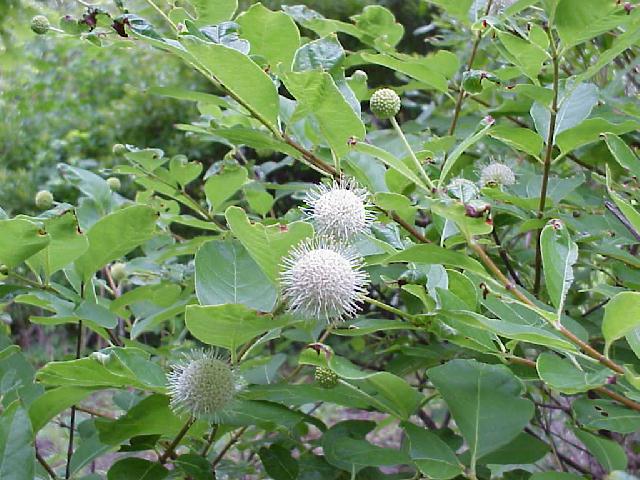
Weird-looking but spectacular are the blooms on Cephalanthus occidentalis, usually referred to as the Buttonbush. The blooms are perfectly round balls or spheres!


Buttonbush is native to the Eastern United States and as far west as Texas. Although you might have never seen one, when found growing naturally, it is usually on the bank of a pond or stream. Close friends of mine have a pond in West Point, Georgia, that is almost completely surrounded with large Buttonbush plants. Such a beautiful sight it is, when in bloom with all the pollinators buzzing around it.

This native shrub absolutely loves water and likes having wet feet all the time, but it can be grown in ordinary garden soil too. Buttonbush is very easy to grow and tolerates almost any soil. Heavy clay is not a problem at all.

The flowers are fragrant, and like many blooms favored by pollinators, smell like honey.

Leaves are dark green and shiny. I have not noticed any pest or disease problems with the buttonbush. This shrub leafs out late, sometimes not until May here in Georgia. The leafs turn a soft yellow in fall before dropping.

Cephalanthus occidentalis will reach heights up to 7 feet or more, and will do so quickly in wet soil.

Plant Buttonbush in full sun or partial shade on a pond or stream bank if you are lucky enough to have one on your property. If not, plant it where you can reach it with a hose on a regular basis. Mine are planted by the greenhouse where I can water it whenever I think it needs it.

Buttonbush will grow in any soil. Regular garden soil is fine. Whatever you have--Heavy to average soil. Clay soil is fine. But amend it with some composted manure or compost to add fertility. 

Cephalanthus occidentalis loves water. Keep soil moist to wet. This shrub even tolerates standing water. Don’t allow to dry out. 

Bumblebees love Blooms on the Buttonbush
The Buttonbush can be grown almost anywhere in the United States, since it is hardy in USDA Zones 4 – 10.

If you want a whole row of them or plan to plant in mass, space them about 5 feet apart.

Buttonbush benefits from being cut back severely every few years to rejuvenate the plant.


Plant a buttonbush in your garden and the bumblebees and butterflies will certainly thank you! I have seen 2 or 3 bumblebees on one flower all at the same time.

Bumble Bees are in Trouble Too!

We often hear about the decline of the honeybee due to overuse of pesticides, herbicides, loss of habitat, and Colony Collapse Disorder (a general term used to express the decline of the honeybee population due to bees leaving the hive to die for reasons we do not know.) But did you know our native bumblebees are in trouble too? Honeybees are not the only pollinator in trouble. Our native bumblebees have faced a sharp decline all across the United States. The loss of bumblebees would severely affect our nation's ecosystem, not to mention our farming system and our food supply.


Bumblebees love our Native Buttonbush,
Cephalanthus occidentalis
As a child I would sit on the back door step and watch bumblebees for an hour or more. The beautiful buzzing little bees just fascinated me. I think the reason there were so many bees there is because it was the only spot in the yard where lots of clover and other wildflowers grew. The bees loved it, and so did I. I enjoyed watching them, but I did not know then how important they are.

Bumblebees are more important to our environment than the non-native honeybees. Bumblebees pollinate native plants and wildflowers that produce seeds for birds and other wildlife. Bumblebees are the most important pollinators for many of the crops we depend on like blueberries and tomatoes. I just learned that farmers actually depend on bumblebees to pollinate crops grown in a greenhouse like peppers, strawberries, and tomatoes. Wow! That is fascinating.

According to the Xerces Society, several species of the North American Bumblebee are on the verge of extinction. The main cause of bumblebee decline is the overuse of pesticides which kill not only the bad insects but also pollinators like the bumblebee.

You might be thinking, "Yes, but what can I do about it?"

Well, first of all, don't use pesticides. Let nature take its course. If you don't spray pesticides on your grass, flowering plants, and shrubs, birds and good bugs like Lady Bugs will take care of the problem naturally.

Secondly, plant flowers. Any kind of flowers. Bumblebees are not picky--they will visit any and every flower available to them. So just plant what you like. Try to have flowers available for them in every season. Here in the mild climate of Georgia, bumblebees are out from late winter to late fall. I've even seen them buzzing around on a warm day in January when our Mahonia was in full bloom.

There might not be much you can do about some some problems occurring in our environment, but this is one area where your actions can definitely make an impact.

If you are interested in trying to identify which kind of bumblebee you are seeing in your garden, take a look at BumbleBee.Org.

Native Bees ID Chart


Identifying the bees on the poster “Join the Conversation about Native Bees”
Written by Stephen Buchmann, Ph.D., Interim NAPPC Coordinator, Pollinator Partnership
  1. Macropis nuda. There’s oil in some flowers. Flowers including Spotted       Loosestrife (Lysimachia spp.) produce energy rich and nutritious floral oils which some female bees (Macropis nuda) collect using modified leg hairs like “oil squeegees” to enrich their brood provisions. This happens in some tropical bees (especially the genus Centris) but in the northeastern USA, only in these interesting little Macropis oil bees.
  2. Agapostemon texanus. US sweat bee (a male Agapostemon texanus) is especially colorful. Males of this species have a shiny green/brassy head and thorax but a wildly contrasting black and yellow-banded abdomen. Look for these bees on sunflowers and other common plants in the late spring and summer. 
  3. Peponapis pruinosa. Squash and gourd bees (like our Peponapis pruinosa) are common bees across much of the United States. They are specialist pollinators preferring the pollen and nectar of squashes, gourds and pumpkin flowers. The genus Peponapis is a colorful bee about the size of a honey bee. They are solitary; each female constructs her own nest with no help from kin, and nest a foot or more underground, usually in or near patches of their favorite cucurbits. 
  4. Bombus impatiens. The Impatient Bumble Bee (Bombus impatiens) is the preferred bumble bee of commerce. Since it can buzz pollinate, while honey bees never do, it is reared in large numbers and its colonies flown to distance localities, greenhouses needing pollinators. Since it does not naturally occur west of the Mississippi, efforts are underway to only allow it to be used in the eastern states as a managed pollinator. Its colors are muted, the yellow hair bands are often more white than a bright yellow. Compare with Morrison’s bumble bee of the western states.
  5. Osmia lignaria. The Blue Orchard Bee (Osmia lignaria) is a member of the leafcutter and mason bee family (Megachilidae). Its distribution includes the Pacific Northwest USA where it is a common visitor to fruit trees in gardens and yards. This bee is often first noticed as females searching for just the right size beetle or nail hole in which to nest and raise their brood. Blue orchard bees are specialists on trees in the rose family and superb pollinator of sweet cherries and other orchard crops. They are currently being tested as pollinators of almonds in California. This bee can be very easily provided for by drilling 7-8 mm diameter holes 5 inches deep into scrap lumber. These “bee condos” can be attached to a garden shed, fence or tree. Nesting females will take up residence and you will be rewarded with bountiful fruit harvests. 
  6. Hylaeus sp. Yellow-faced bees (Hylaeus spp.) usually go unnoticed by most gardeners and hikers. These slender black/brown bees are relatively hairless and most think they are wasps. Under a microscope, they are distinctive with a bright yellow face. The only bees natives to Hawaii are a group of these Hylaeus. Due to habitat fragmentation and loss in the Hawaiian Islands, several of these rare native bees have gone extinct, while others are declining. Hyleaus nests in hollow stems. Unlike most bees, Hylaeus carries its pollen and nectar back to the nest internally, inside the crop, or honey stomach.
  7. Habropoda laboriosa. The Southeastern Blueberry Bee (Habropoda laboriosa) is a digger bee (anthophorid in the family Apidae) from southeastern states including Alabama, Mississippi and Louisiana. This handsome large gray bee is an efficient pollinator of southern rabbit eye blueberries. This is one of the bees, unlike honey bees, which uses sonication, produced by rapid flight muscle contractions, to eject pollen grains from the blueberry flowers.
  8. Xylocopa varipuncta. Males of the Valley Carpenter Bee (Xylocopa varipuncta) are common in the southwestern states. These bees have striking colors, a large golden amber body with long hairs and brilliant green eyes. During the spring, males leave the nest galleries in which they emerged, inside a large log or tree branch and go courting. They establish hovering territories in a non-flowering shrub or tree and release a pheromone, a rose-scented blend of volatiles from within massive thoracic glands. Passing females decide which male to mate with based up his particular bee “cologne.”
  9. Bombus morrisoni. Morisson’s bumble bee (Bombus morrisoni) is one of the most colorful bumble bees found in western and southwestern states. It’s mostly yellow fuzzy body attracts our attention as it visits diverse flowers in gardens and native wildflower areas. This bee is one of several that turns its body into a living tuning fork on plants with pored anthers, like tomatoes or deadly nightshades (Solanum spp.). Other species are managed for greenhouse pollination of tomatoes which require this form of buzz pollination. 
  10. Perdita minima. The smallest bee in the United States is only 2.0 mm (about 1/16th of an inch) long. These small amber colored bees (Perdita minima) in the andrenid family nest in the soil and visit the small white flowers of mat-forming Euphorbiaceae that come up in sidewalk cracks and along dirt roadways in the southwestern states.
  11. Xylocopa virginica. Many gardeners mistake the Eastern Carpenter Bee (Xylocopa virginica) for a large bumble bee. Although both bees are large and colorful, they are only distantly related, both belonging to the large family Apidae. Carpenter bees collect pollen and nectar from a wide variety of plants, thus they are known as generalist feeders. Large carpenter bees construct their nests inside dead but sound wood. Sawdust scrapings are glued together to form the first “particle board” separating individual brood cells within their long galleries. In the east, X. varpipuncta is a minor structural timber pest, often constructing its galleries in sheds, outdoor beams or fence posts. On the bright side, these bees are amazing to watch at flowers or at their nests, and it takes decades of residency before there is any serious structural damage to support beams. The females reuse the same nesting tunnels year after year. 
  12. Bombus vosnessenskii. The Yellow-faced bumble bee (Bombus vosnessenskii) is a handsome bumble bee mostly black with a yellow face and prothorax and narrow yellow abdominal band. It occurs in the western states of California, into Nevada, Washington, Oregon and into British Columbia. It does not seem to have been affected, in decline, like the formerly widespread Western Bumble Bee (Bombus occidentalis)13. Bombus affinis. The Rusty-patched bumble bee (Bombus affinis) is a bee that was formerly common across large areas of the United States from the Midwestern states to the northeast. It started to become rare in its former ranges after 1997. The reason(s) for its demise are not entirely settled but may include pathogen spillover from European parasites, contamination in the greenhouse bumble bee rearing industry. 
  13. Bombus affinis. The Rusty-patched bumble bee (Bombus affinis) is a bee that was formerly common across large areas of the United States from the Midwestern states to the northeast. It started to become rare in its former ranges after 1997. The reason(s) for its demise are not entirely settled but may include pathogen spillover from European parasites, contamination in the greenhouse bumble bee rearing industry. 
  14. Megachile sp. Leafcutter bees like this handsome Megachile sp. are members of a very diverse family, the Megachilidae, which includes the leafcutter, resin and mason bees. Females of many of these bees get their name from the pieces of leaves they collect. Have you seen neat circles clipped from the edges of rose bushes or other plants? These leaf pieces are used to line the brood cells; literally the bees are usurping the chemical defenses, against microbes, found in the leaves. Please tolerate some non-harmful cosmetic damage that the females cause and you’ll be rewarded with bountiful harvests in your home garden or orchard.
  15. Andrena cornelli. Miner bees, the family Andrenidae, are represented by the huge genus Andrena, with over 2,000 described species. Females of Andrena cornelli are common spring visitors to the large pink flowers of eastern Azalea (Rhododendron canescens). The cobwebby pollen of these flowers are carried away in strings as brood food by the Andrena females.
  16. Anthophora centriformis. Digger bees, or anthophorids like this Anthophora centriformis are members of the large family Apidae. Anthophora species are large, strikingly colored fast-flying bees that visit tubular flowers like Penstemon (“beardstongue”) in gardens and natural areas. Most digger bees nest in the ground and are solitary, living out their lives without any help, like solitary wasps. 
  17. Nomada sp. The Wandering Cuckoo Bee (Nomada sp.) is a type of digger bee (family Apidae) which does not collect pollen to feed its brood. These colorful and nearly hairless bees are cleptoparasites, or cuckoos in the nest of other bees. Like cowbirds, a female cuckoo bee sneaks her own egg in the nest while the host female is away. Once hatched, the cuckoo bee kills the host egg or larva and consumes the pollen and nectar provisions left by the host female. 
  18. Augochorella pomoniella. Sweat bees like this beautiful metallic green Augochorella pomoniella are members of the large and diverse “sweat bee” family, the Halictidae. This southwestern species is a common resident of Arizona and adjoining states. These bees have sparse hairs and their integument is a shiny metallic green.

The above information was borrowed from The Pollinator Partnership.

June Blooms in my Georgia Garden: Oakleaf Hydrangea

This time of year our garden is always bursting with blooms, but this year has been a little different. Due to a very mild winter, everythin...